Last updated October 30, 2026
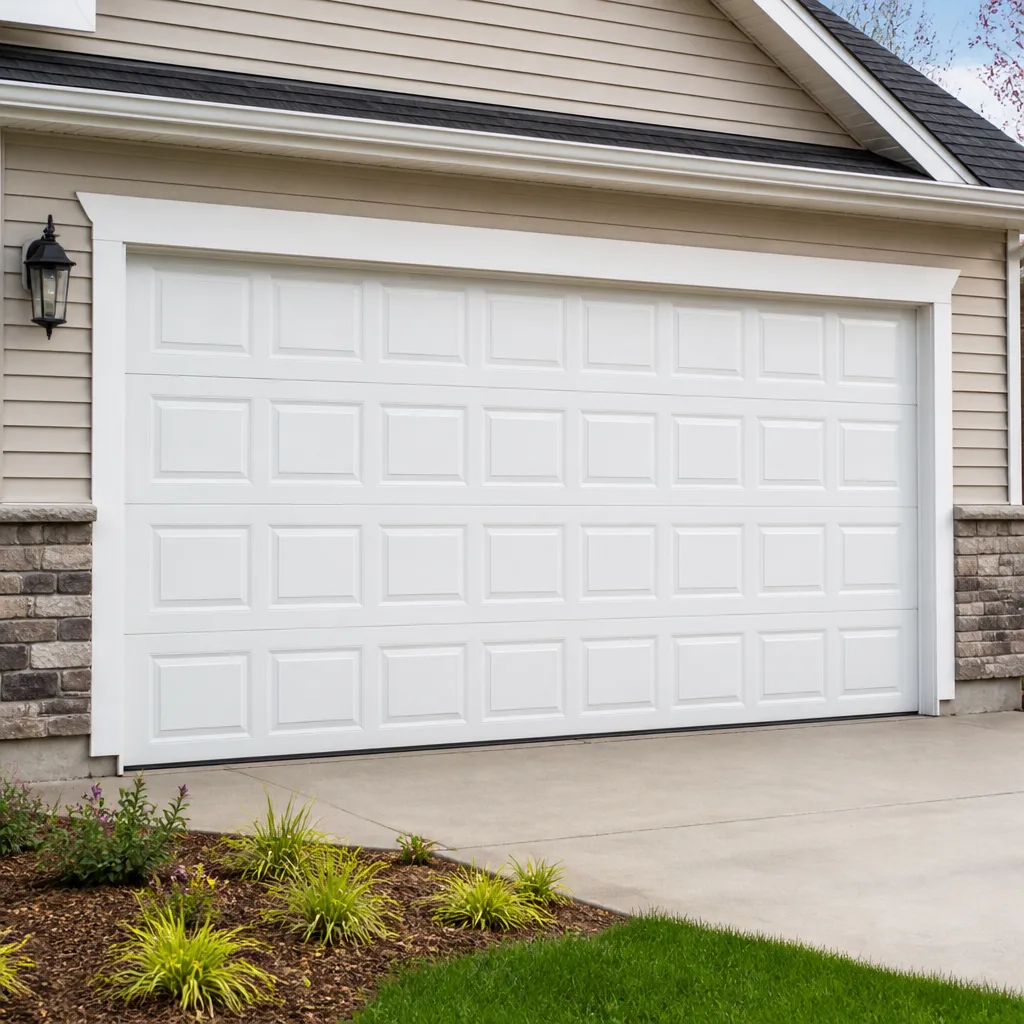 Raised-panel steel
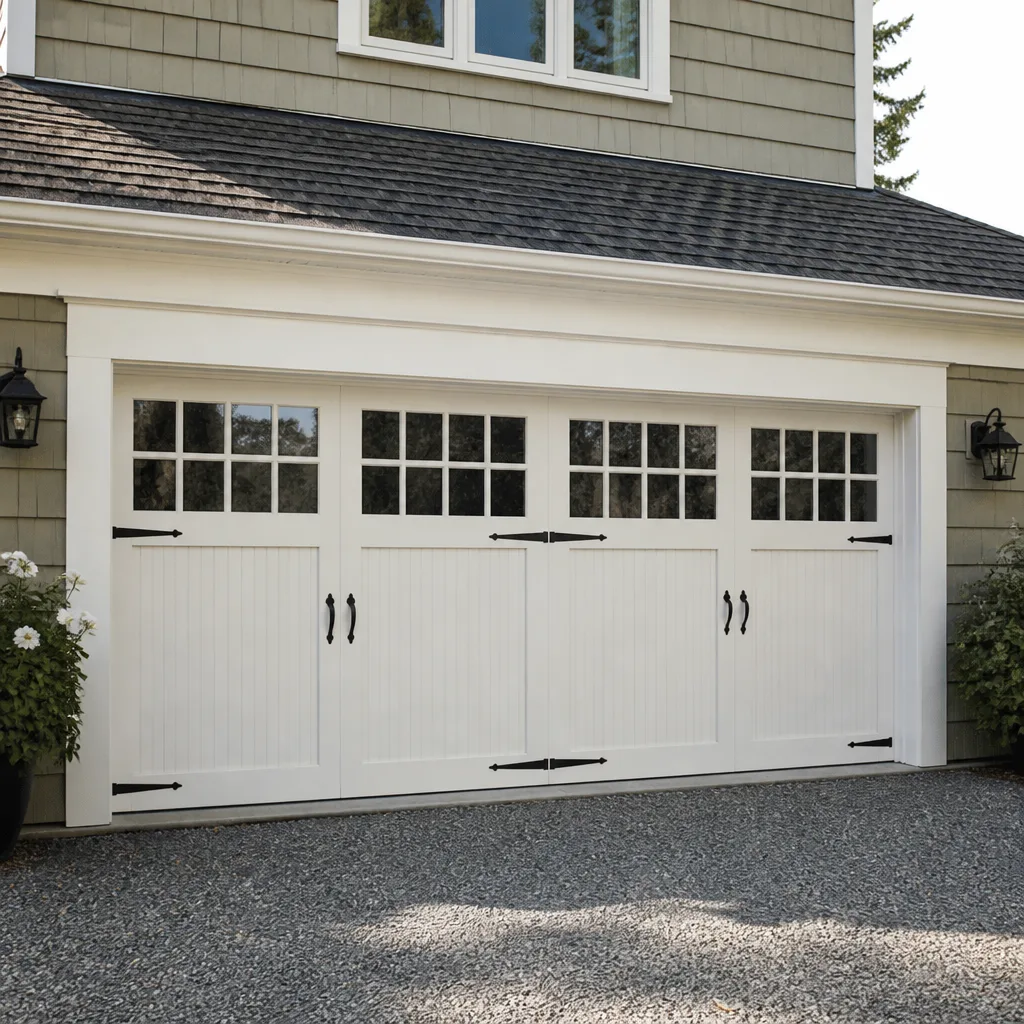 Carriage house
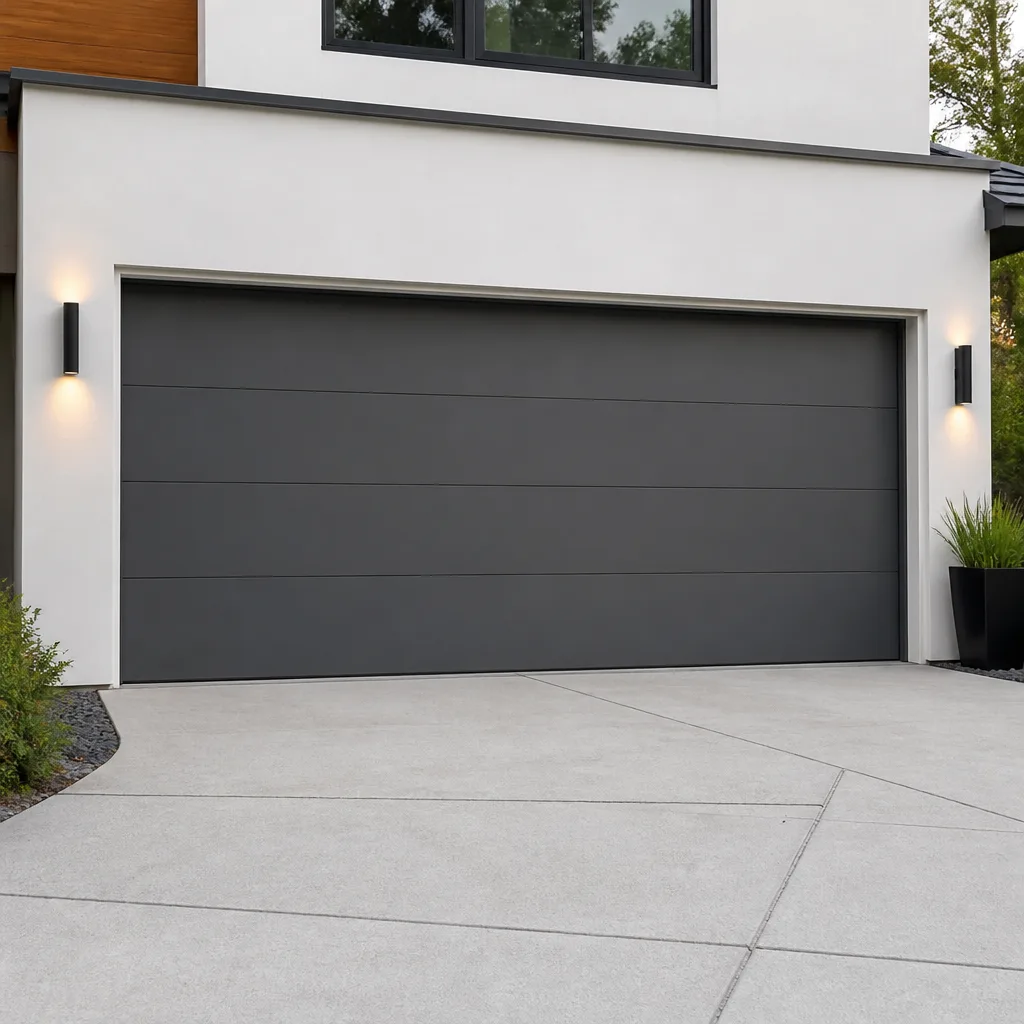 Modern flush
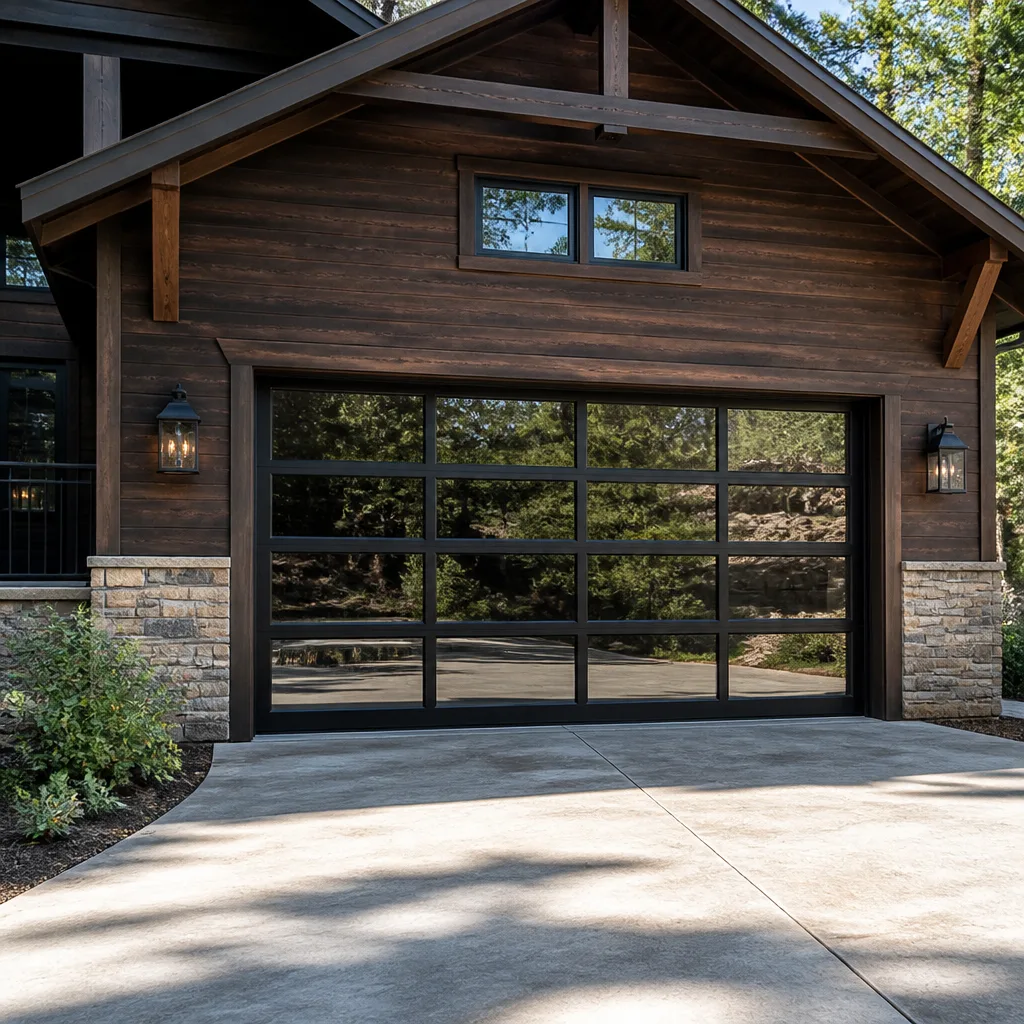 Full-view glass
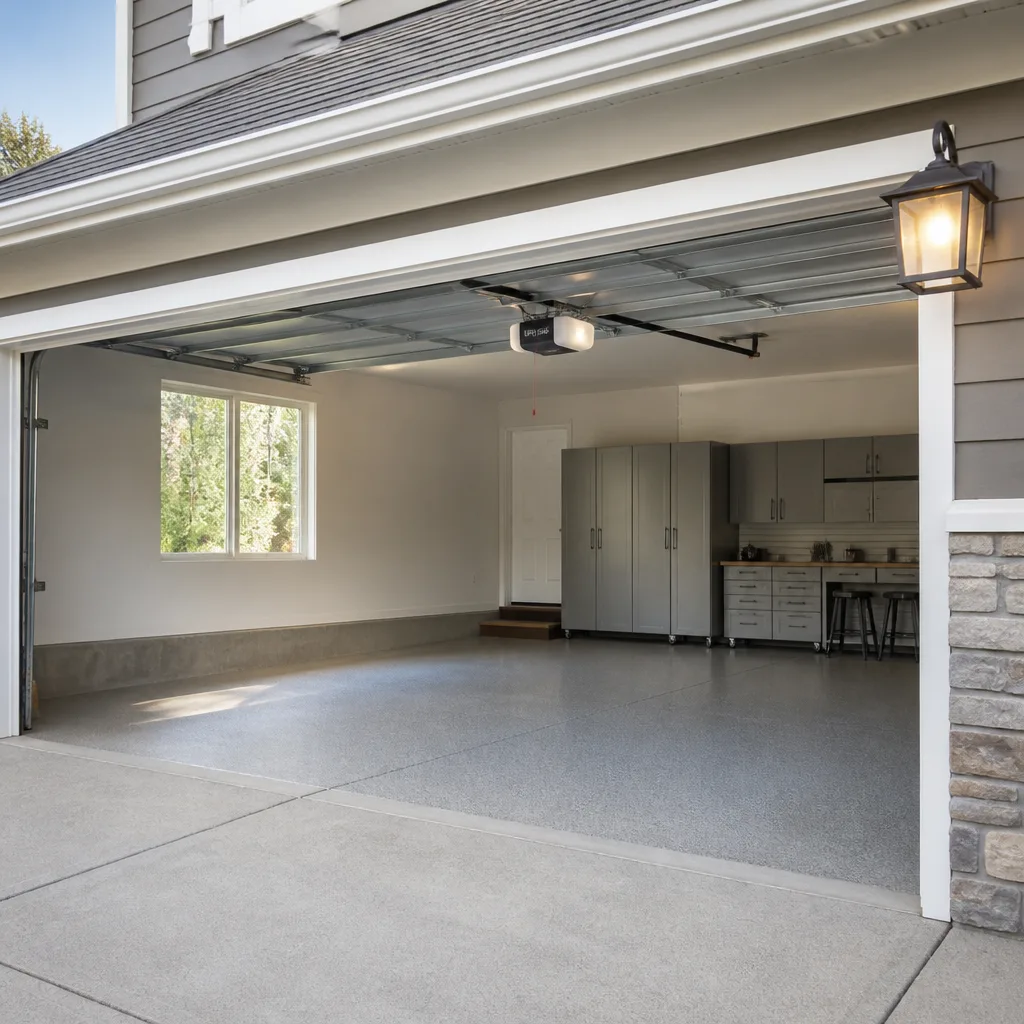 LiftMaster openers
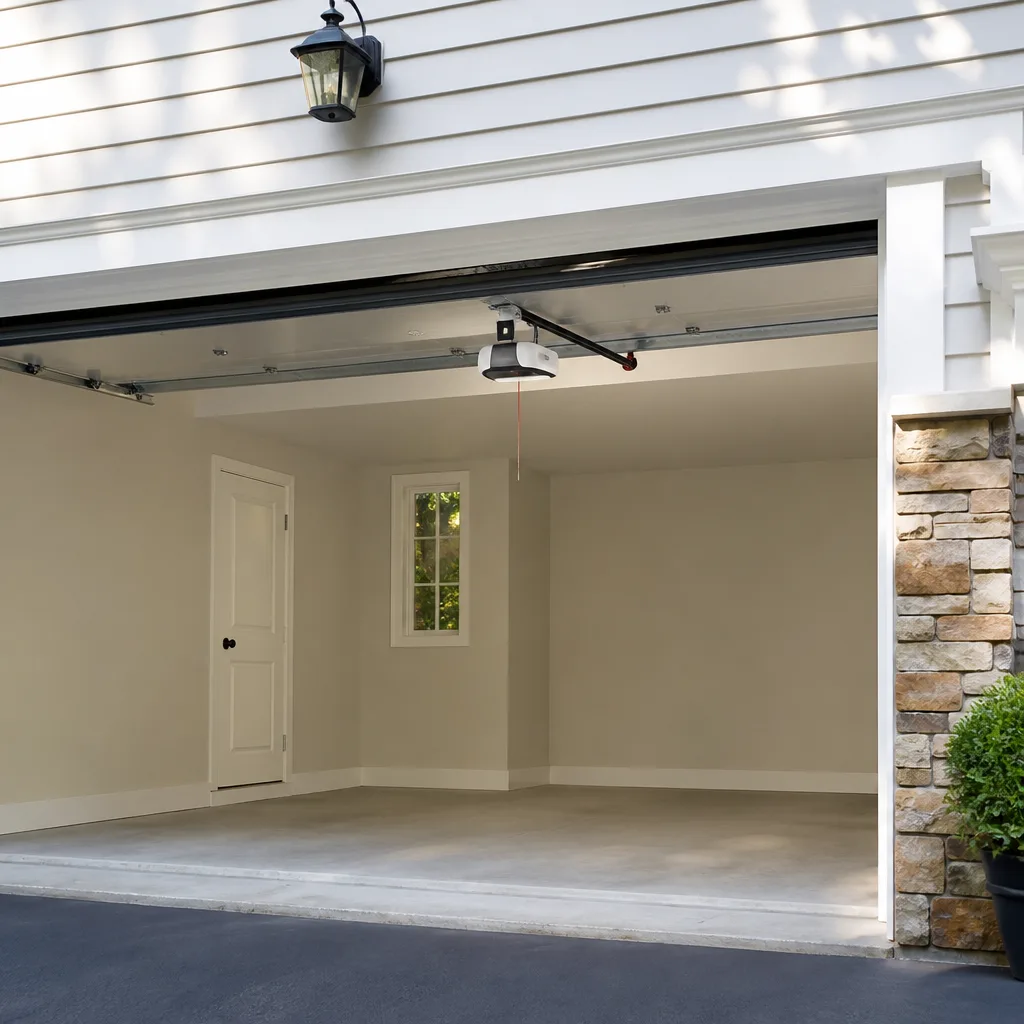 Chamberlain openers
Full 25-point door and opener safety check with every visit - springs, cables, rollers, tracks, and your LiftMaster or Chamberlain opener included
You get a price before we start. It does not change when the truck arrives.
Get your free estimateGarage Door Repair Maintenance Checklist for West Palm Beach Homeowners
Garage door springs in West Palm Beach fail 30 to 40 percent faster than the manufacturer’s cycle rating suggests. Not because of overuse. Because humidity accelerates metal fatigue in ways most generic maintenance guides never mention. A checklist written for Ohio or Michigan will have you greasing hinges that don’t need it while completely missing the corrosion eating your torsion spring from the inside out. This guide is different. It’s sequenced around the actual failure modes we see in South Florida: humidity, salt air, heat cycling, and torrential rain. By the end, you’ll know exactly what to check monthly, what to leave alone, and when to call a specialist for Garage Door Repair services before a small problem becomes a door that won’t open. West Palm Beach punishes neglected garage doors harder than almost any climate in the country.
Quick Answer
A West Palm Beach garage door maintenance checklist should focus on corrosion, lubrication with heat-stable products, track alignment after heavy rain, and spring inspection, not the seasonal tasks northern guides emphasize. Homeowners can safely handle visual inspections, cleaning, and weatherseal checks, but anything involving spring tension, cable replacement, or track realignment must be left to a trained technician. The most effective schedule here is monthly visual checks plus two deeper inspections each year, one before hurricane season and one after.
Styles & brands we work with
Table of Contents
- Why West Palm Beach Needs a Different Checklist
- Monthly Homeowner Inspection
- The Humidity and Corrosion Protocol for Coastal Homes
- Lubrication Done Right: What to Use, What Destroys Your Door
- The 12-Month West Palm Beach Garage Door Calendar
- Tasks Only a Technician Should Do, and Why
- Signs Your Door Needs Repair Now
- Common Mistakes to Avoid
- When to Call a Professional
Why West Palm Beach Needs a Different Checklist
Most garage door maintenance articles are written for four-season climates, so for more guides & resources tailored to your area, check our blog. They talk about winterizing, about frozen rollers, about lubricating hinges before the first frost. None of that applies here. What applies in West Palm Beach is humidity that averages above 70 percent year-round, salt particles in the air for homes within five miles of the Intracoastal, afternoon thunderstorms that dump two inches of rain in an hour, and summer heat that turns a closed garage into a 130-degree oven.
Each of those factors attacks a different part of your door. Humidity weakens torsion springs through a process called hydrogen embrittlement, which is why springs here snap earlier than their rated cycle life. Salt air corrodes the galvanized coating on cables and hardware, leaving rust that abrades rollers and increases operating friction. Heat cycling expands and contracts metal panels and tracks, gradually loosening bolts and shifting alignment. Heavy rain finds every gap in your bottom seal and floods the track bases, where standing water accelerates rust on the hardware that matters most.
A maintenance checklist for this climate has to be built around those four threats. If your current routine is “spray some WD-40 on it once in a while,” you’re not maintaining your door. You’re delaying a repair bill. And in West Palm Beach, delayed garage door problems have a way of becoming urgent at 7 a.m. when you need to get to work and the door won’t budge.
The good news is that the right maintenance takes about fifteen minutes a month and two longer inspections a year, and it will measurably extend the life of a door that would otherwise need replacement years earlier. Many of our service calls in West Palm Beach come from homeowners who learned the cost of skipping these steps the hard way. We’d rather you not join that list.
Monthly Homeowner Inspection
This is the monthly routine any West Palm Beach homeowner can safely do without tools beyond a flashlight and a clean rag. It takes fifteen minutes. It will catch ninety percent of developing problems before they cause a breakdown.
- Watch and listen during one full open-close cycle. Stand inside the garage with the door opener engaged. The door should move smoothly, without jerking, scraping, or grinding. Any new sound is diagnostic. Grinding typically means worn rollers. Scraping means track contact. A bang when the door starts moving means a spring issue.
- Check the bottom seal for cracks and gaps. Run your hand along the rubber strip at the bottom of the door. In West Palm Beach, this seal hardens and cracks from heat plus humidity, usually within two to three years. A cracked seal lets rainwater, insects, and humid air into the garage. You should not see daylight under the door when it’s closed.
- Inspect visible hardware for rust. Look at the hinges, the roller stems, the cable ends, and the track brackets. In homes near the Intracoastal, rust appears faster, sometimes within a year on exposed hardware. Surface rust on hinges is cosmetic. Rust on cables or springs is a repair indicator.
- Wipe down the tracks. Use a dry rag to remove dust, salt residue, and debris from the vertical and horizontal tracks. Do not apply any lubricant to the tracks. Lubricated tracks cause rollers to slip, which increases wear on the roller bearings. Tracks should be clean and dry.
- Test the auto-reverse safety feature. Place a roll of paper towels or a 2×4 flat on the ground in the door’s path. Close the door. It should reverse within two seconds of contact. If it doesn’t, disconnect the opener and operate the door manually until a technician can service the safety system.
- Check the balance. Pull the red emergency release handle to disconnect the opener, then lift the door manually to waist height. It should stay put. If it drops, the springs are losing tension. If it shoots up, the springs are over-tensioned. Either condition is a spring issue that needs a technician’s attention.
That’s the entire homeowner monthly list. No spring adjustments. No cable work. No track realignment. Those are on the technician-only list for a reason, and we’ll cover that below.
The Humidity and Corrosion Protocol for Coastal Homes
If your West Palm Beach home sits within five miles of the Intracoastal or the ocean, you need an additional inspection layer that inland homes can skip. Salt air is relentless here. It settles on every metal surface in your garage, mixes with humidity, and creates a corrosive film that eats through protective coatings far faster than the same hardware would degrade in, say, Wellington or Royal Palm Beach.
Here’s the protocol we recommend for coastal West Palm Beach homeowners every quarter:
- Cable inspection at the drum and bottom bracket. Look closely at the steel cables where they wrap around the drum at the top of the door and where they anchor to the bottom bracket. These two points carry the highest tension and collect the most salt residue. Fraying strands, rust discoloration, or a powdery white film on the cable are early warning signs. Cables under tension should never be touched or replaced by a homeowner.
- Roller stem rust check. The small metal stems that hold each roller can rust enough to seize the roller, which then drags along the track instead of rolling. A seized roller wears a flat spot, creates drag, and eventually destroys the track. Coastal homes should expect to replace rollers more frequently than inland homes.
- Bottom bracket and hinge surface rust. Light surface rust is normal within a year or two near the coast. Heavy scaling rust on the bottom brackets means the structural hardware is degrading. These brackets hold the cables, which hold the spring tension. We replace these on coastal homes far more often than on inland ones.
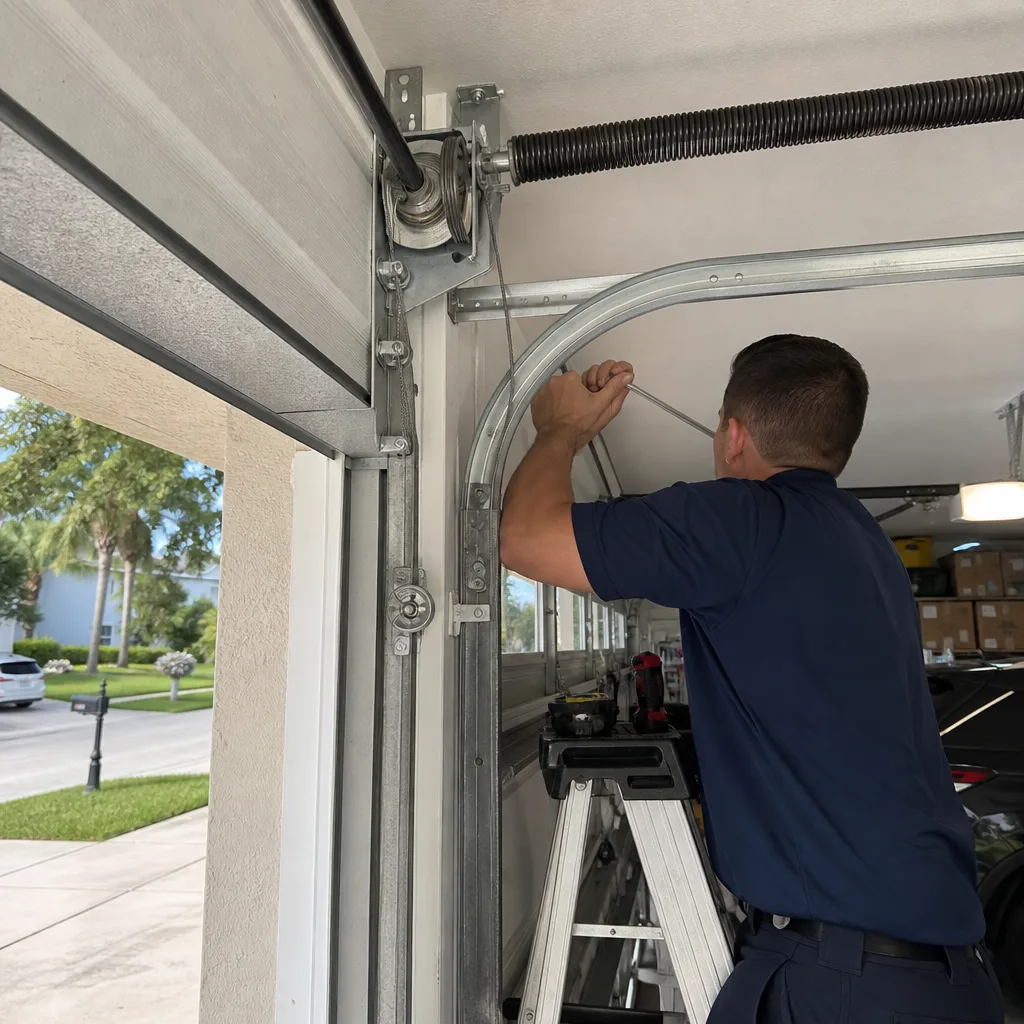
- Spring corrosion. This is the most important check. Look at the torsion spring above the door opening. Surface rust on the outside is bad enough. The real threat is the rust you can’t see, working its way into the microscopic surface imperfections of the spring coil. Humidity plus salt accelerates that process measurably. A spring with visible rust patches or pitting is on borrowed time, regardless of how many cycles the manufacturer rated it for.
- Opener and electrical contact corrosion. Openers mounted in coastal garages accumulate salt film on their circuit boards and wall buttons. If your wall button occasionally fails to respond or the opener hesitates, salt exposure is a likely contributor. A technician can clean the contacts and assess whether the opener needs replacement or is still serviceable.
We regularly see coastal West Palm Beach doors fail at five or six years old when the identical door, installed ten miles inland, would run for ten. That’s the salt tax. The quarterly protocol is how you avoid paying it.
Lubrication Done Right: What to Use, What Destroys Your Door
Lubrication is the single most misunderstood part of garage door maintenance, and in West Palm Beach’s heat, the wrong product does more damage than no product at all. Here’s the direct answer: use a lithium-based or silicone-based spray lubricant designed for garage doors. Never use WD-40. Never use grease. Never use motor oil. And never lubricate nylon rollers with anything but a dry silicone spray.
WD-40 is a solvent, not a lubricant. It’s designed to displace moisture and break up rust, which it does, and then it evaporates, leaving metal surfaces with less lubrication than they had before. It also breaks down the plastic bearings inside nylon rollers, which accelerates roller failure. Grease attracts dust, sand, and salt particles, creating an abrasive paste that grinds away at hinges and roller bearings. In Florida’s coastal environment, that paste forms faster and does more damage.
Here’s what to lubricate and what to skip:
- Lubricate the torsion spring. A light coat of lithium spray on the spring coil reduces friction between coils as the spring winds and unwinds. This directly extends spring life. In coastal homes, do this quarterly. Inland, every six months is fine.
- Lubricate the roller bearings. Metal rollers with ball bearings need a drop of oil at the bearing. Nylon rollers do not need oil at the bearing and should only receive a light silicone spray to keep the nylon from drying out. Most newer West Palm Beach homes have nylon rollers.
- Lubricate the hinge pivot points. A short spray at each hinge pivot keeps the door sections moving smoothly as the door bends through the track radius.
- Lubricate the opener chain or screw drive. Chain-drive openers need periodic chain lubrication. Screw-drive openers need white lithium grease on the screw. Belt-drive openers need nothing, which is one reason they’re common in newer installations.
- Do not lubricate the track. The rollers need friction against the track to roll instead of slide. A lubricated track causes slippage, flat spots on rollers, and accelerated track wear.
- Do not lubricate the bottom seal. The rubber bulb at the bottom of the door needs to stay clean and flexible, not coated in an oil-based product that will accelerate rubber degradation in the heat.
In West Palm Beach’s summer, a closed garage gets hot enough that oil-based lubricants thin out and drip onto the door surface, the track, and your car. Silicone and lithium products hold up under that heat without running. That’s a practical consideration northern guides never address.
The 12-Month West Palm Beach Garage Door Calendar
West Palm Beach doesn’t have four seasons. It has two: the hot wet season from May through October and the warm dry season from November through April. Maintenance should map to that pattern, not to a northern spring-summer-fall-winter template.
January – February: Full inspection. This is dry-season prime, the best time for a thorough check of every component. Clean the tracks, inspect the springs, test the balance, and check the weatherstripping. If you need a repair or adjustment, this is the easiest time of year to schedule it before the summer rush. For homeowners in Loxahatchee Groves, our Garage Door Repair in Loxahatchee Groves page covers how we approach this exact service area.
March – April: Pre-hurricane-season prep. Test the door’s wind-load resistance by checking all track bolts for tightness. Confirm the opener has a working battery backup if your home had one installed. Check the bottom seal for any gaps that summer rains will exploit. This is also the time to address any rust spots you noticed during the monthly inspections.
May – June: Rainy season begins. The first weeks of daily thunderstorms are the highest-risk window for track warping and bottom seal failure in Florida. Afternoon heat builds, then rain cools the metal rapidly. Repeated thermal cycling can bow a horizontal track enough to bind the rollers. Inspect tracks weekly during this transition.
July – September: Peak humidity and heat. Increase coastal corrosion inspections to monthly if you’re within five miles of the Intracoastal. Re-lubricate springs and hinges mid-summer. Watch for signs of opener overheating: sluggish response, thermal shutdowns, or the opener reversing for no reason at the top of the cycle.
October: Post-rainy-season inspection. Check for water damage at the track bases and bottom brackets. Look for rust that formed during the wet months. Clean any organic debris, including leaves and palm fronds, that collected along the tracks or in the weatherseal channel.
November – December: Cool dry season. Perform a second full inspection. If the door is older than ten years and the springs have visible rust, consider replacing them proactively during this window rather than waiting for a failure. Operating noise is typically at its lowest in the dry season, so any new sound stands out clearly.
This calendar reflects the actual environmental cycle of West Palm Beach. Following it means your door is being checked at the moments when failures are most likely to begin, not at arbitrary calendar dates chosen by someone who’s never been here.
Tasks Only a Technician Should Do, and Why
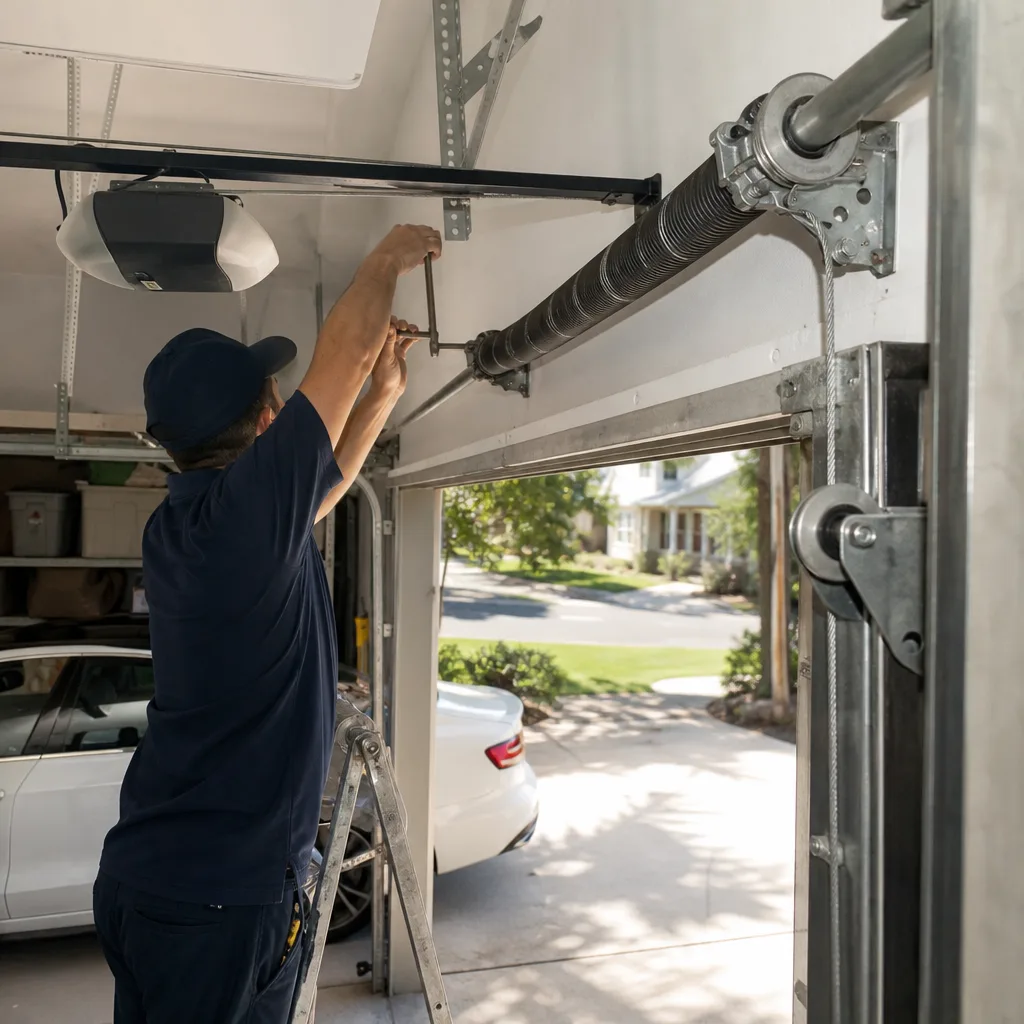
There’s a line between homeowner maintenance and technician work, and in garage doors that line is drawn by spring tension. A torsion spring under load stores enough energy to cause severe injury or death if mishandled. Same for extension springs and the cables that carry that tension. This is not a “be careful” situation. This is a “do not touch this at all” situation.
Here are the tasks that require a trained technician, with the reason for each:
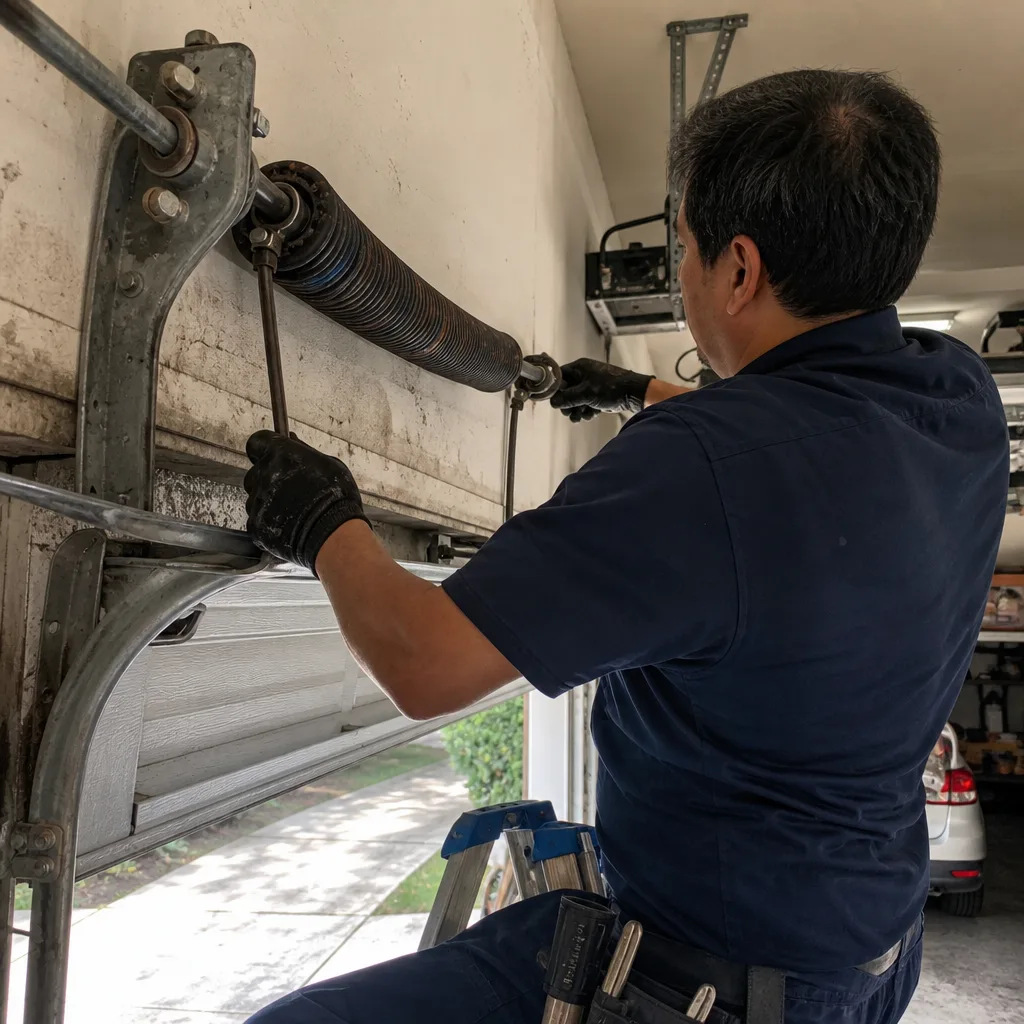
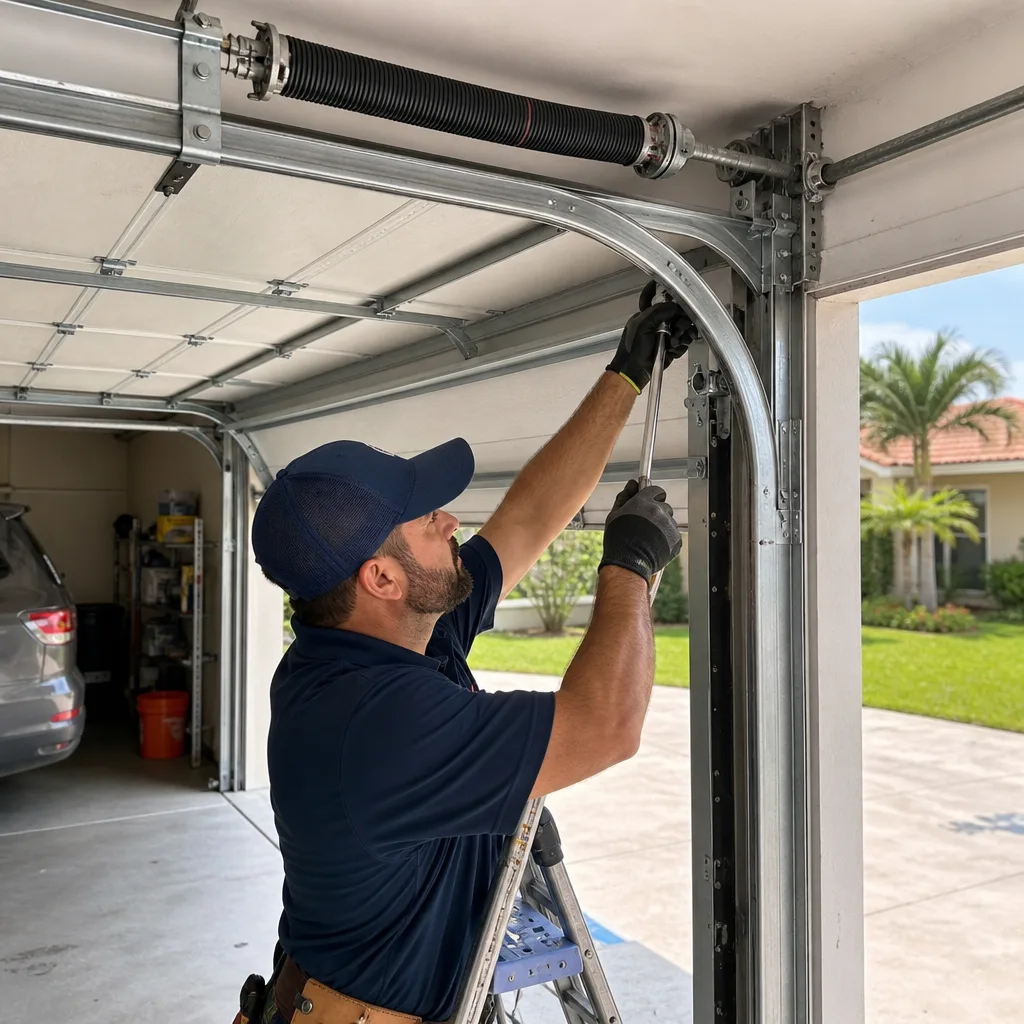
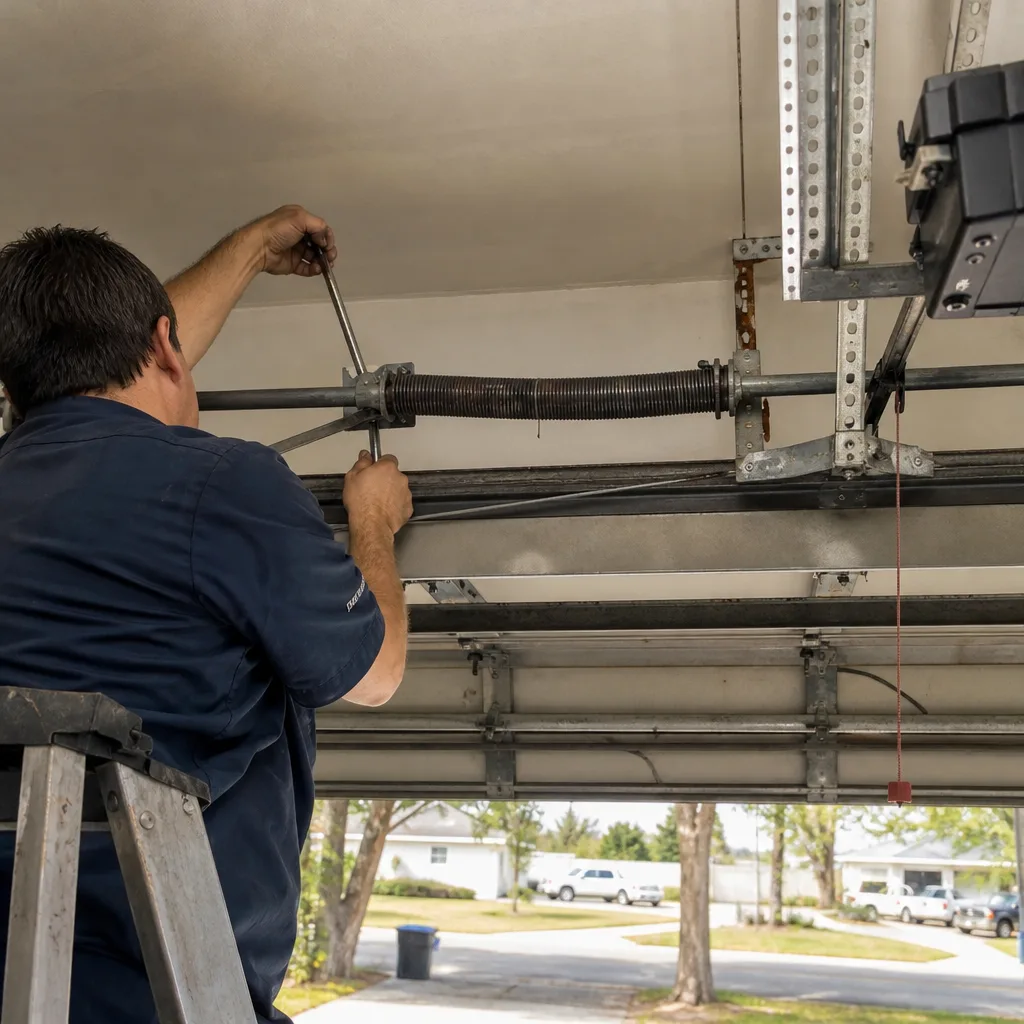
- Spring replacement or adjustment. Torsion springs are wound under 100 to 200 pounds of torque depending on the door weight and size. One wrong move with a winding bar can release that energy instantly. We’ve seen the injuries that result. Never attempt to adjust or replace a spring yourself.
- Cable repair or replacement. The cables work in tandem with the springs and carry the same tension. A cable that snaps under load can whip through the garage with enough force to cause serious injury. Cable work is always a technician’s job.
- Track realignment. This seems simple: loosen a bolt, tap the track, tighten it. But a track that’s out of alignment is usually a symptom of something else: a shifting wall, a loose bracket, a damaged roller, or structural settling. A technician diagnoses the cause, not just the symptom.
- Opener gear and sprocket replacement. The opener’s internal gears wear down over years of use, and the symptom is a grinding noise or a door that won’t move. Rebuilding an opener gear assembly requires opening the unit and working with the sprocket, which carries the door’s weight. This is one of our most common West Palm Beach service calls, particularly on older LiftMaster and Chamberlain units.
- Panel replacement. A dented or cracked panel might look bolt-on, but panels are connected to the door’s structural balanced weight. Replacing one changes the door’s weight distribution, which changes spring requirements. A technician calculates the new balance before and after the panel swap.
- Bearing replacement at the torsion tube. The center bearing and end bearings on the torsion tube wear out over time. The symptom is a grinding or squealing noise from above the door during operation. This requires loosening the spring system, so it belongs firmly in the technician-only category.
The reason we’re so specific about this line isn’t to generate service calls. It’s because every year, emergency rooms treat injuries from garage door spring failures, and many of those injuries happened to homeowners who were trying to save a service fee. In West Palm Beach, where springs fail faster than average due to humidity, the risk is constant. Know the line, and stay on your side of it.
Signs Your Door Needs Repair Now
Some garage door problems develop slowly and can wait for a scheduled appointment. Others are active failures that should be addressed the same day. Here’s how to tell the difference in West Palm Beach’s climate, where a minor issue becomes urgent fast once the rain starts.
- The door won’t open or won’t close. This is an immediate call, especially if the door is stuck open, because an open garage is an open invitation to every insect and rainstorm in Palm Beach County. If the door is stuck closed and your car is inside, you already know how urgent it feels.
- You hear a loud bang from the garage. That’s a spring snapping, the single most common catastrophic garage door failure in West Palm Beach. The door will feel impossibly heavy if you try to lift it manually, because the spring isn’t there to counterbalance the weight anymore. Do not try to force it. Call a technician.
- The door opens a few inches, then stops or reverses. This often points to a broken spring, a bound roller, or an obstruction sensor issue. If it’s a spring, continued use of the opener will burn out the opener motor. Turn the opener off and have it evaluated.
- The door is crooked when moving or sitting unevenly when closed. An uneven door means a cable problem, a spring problem, or a track problem. All three get worse with continued use. The door is no longer distributing its weight evenly, which means every component is under abnormal stress.
- You see frayed cables or rusted-through springs. If you can see the damage, the failure is measured in weeks, not months. The humid West Palm Beach air will finish the job. This is the time to schedule a repair proactively rather than waiting for the loud bang.
- The opener runs but the door doesn’t move. This usually means the opener’s internal gear has stripped, a common failure on older openers across all brands. It’s a separate issue from the door itself and requires opener-specific repair, which we handle as a standalone service rather than bundling it into a door repair or routing it to the manufacturer.
If you’re experiencing any of these, the diagnostic question isn’t “can it wait?” but “what else will break if it does?” A snapped spring left unaddressed burns out the opener motor. A frayed cable that fails damages the panel it catches on. In garage doors, secondary damage is often more expensive than the original repair would have been.
Common Mistakes to Avoid
- Using WD-40 as a lubricant. It’s a solvent that strips lubrication and breaks down nylon roller bearings. In West Palm Beach’s humidity, the unprotected metal rusts faster after WD-40 evaporates than if you’d done nothing at all.
- Lubricating the tracks. This causes rollers to slide instead of roll, wearing flat spots and accelerating track damage. Tracks should be clean and dry, full stop.
- Ignoring a noisy door. Noise is diagnostics. A grinding sound is a roller failing. A squeal is a bearing. A bang on startup is a spring. In South Florida, a noisy door is a door announcing its next failure. Ignoring it doesn’t make the repair cheaper.
- Rust-painting over corroded hardware. Spray-painting surface rust on springs, cables, or brackets hides the problem without fixing it. The corrosion continues underneath, and you lose the visual early-warning signal. If rust is visible on a load-bearing component, have it evaluated, not painted.
- Forcing a door that resists. When a door doesn’t move easily with the opener disconnected, forcing it manually concentrates all the stress on the weakest component, usually the cables or hinges. If it doesn’t move smoothly by hand, stop and call someone who knows what they’re looking at.
- Skipping the corrosion checks because the door is new. New doors still have springs, cables, and brackets. Near the Intracoastal, we see corrosion on new installations within the first two years. New doesn’t mean exempt from this climate.
- Following a northern maintenance schedule. Lubricating at the first frost, winterizing, checking for ice damage. None of that applies here. The West Palm Beach schedule follows humidity, rain, and heat, not temperature drops.
When to Call a Professional
Call a professional for any spring issue, any cable issue, any track realignment, any opener internal failure, or any time the door doesn’t operate smoothly under manual operation. That’s the entire list. Homeowner maintenance is visual inspection, cleaning, lubrication with the right product, and weatherseal replacement. Everything else is technician work, and in West Palm Beach, the humidity means delaying technician work carries a compounding cost. If you’re seeing rust on your springs, hearing new sounds, or your door is becoming an unreliable partner, that’s the moment to make the call, not after it fails at the worst possible time. West Palm Beach Garage Door Co offers free estimates in West Palm Beach, call (877) 265-9120 and we’ll give you an honest assessment of what needs attention, what can wait, and what it’ll cost before any work begins.
See the difference
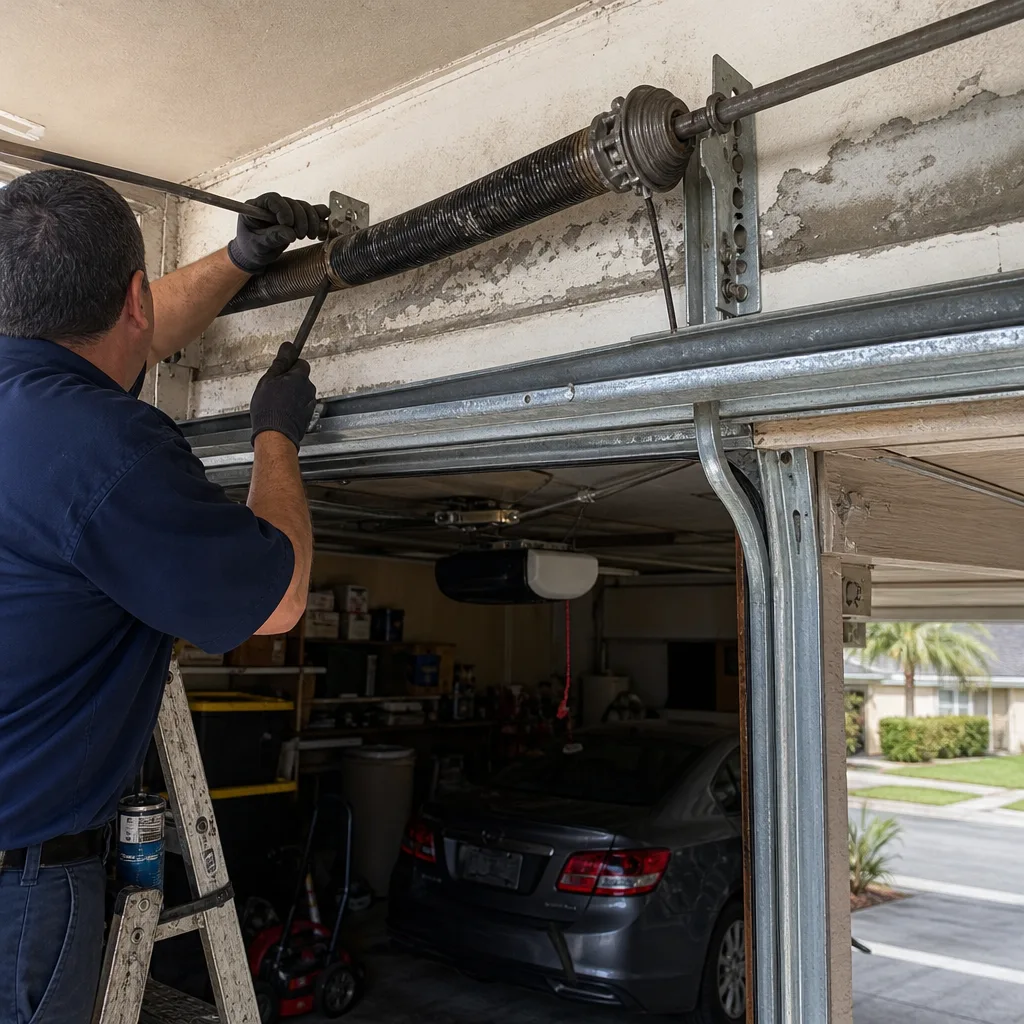 Before
 After
 Before
 After
 Before
 After
Frequently Asked Questions
Every six months for inland West Palm Beach homes, and every three months for homes within five miles of the Intracoastal or ocean. The humidity and salt air strip lubrication faster near the coast. Use a lithium or silicone spray on the spring, hinges, and roller bearings, and never use WD-40. If your door still sounds dry or squeaks after lubrication, call (877) 265-9120 and we’ll check whether a bearing or roller needs replacement instead.
A basic inspection and lubrication visit in West Palm Beach typically runs $75 to $150 depending on the door type and whether the opener is included. More involved maintenance, like replacing worn rollers or a bottom seal, adds parts cost, which varies by door size and material. Your actual price is quoted and agreed before any work starts. Call (877) 265-9120 for an exact quote, the estimate is free.
A standard torsion spring rated for 10,000 cycles might last eight to ten years in a dry climate, but in West Palm Beach’s humidity we typically see springs fail at six to eight years, and sometimes earlier in coastal homes where salt accelerates corrosion. The tell-tale signs are visible rust patches on the spring coil or a door that’s getting harder to lift manually. If your springs show either, they’re on borrowed time regardless of their rated cycle count.
No. Garage door springs are under enough tension to cause severe injury or death if removed incorrectly. This is the one task that should never be attempted by a homeowner, no matter how many YouTube videos you’ve watched. In West Palm Beach, the DIY spring replacement injuries we hear about most often come from homeowners using improvised winding bars instead of the proper tools. Call (877) 265-9120 and a trained technician will handle the spring replacement safely with the right equipment.
West Palm Beach’s summer rain cycle causes rapid heating and cooling of garage door tracks, which can loosen the bolts holding the track to the wall. The repeated thermal expansion and contraction, especially during the afternoon thunderstorm pattern from May to October, gradually backs bolts out and shifts the track alignment. Checking track bolts monthly during the rainy season and tightening any loose ones with a hand wrench will prevent most of these issues before the track misaligns enough to bind the rollers.
Yes, and more than most homeowners realize. Homes within five miles of the Intracoastal or ocean experience accelerated corrosion on springs, cables, roller stems, and opener circuitry from the salt particles that settle on everything in the garage. We’ve replaced springs on five-year-old doors near the Intracoastal that would have lasted a decade inland. The quarterly corrosion protocol in this guide is specifically designed to catch that salt damage before it becomes a catastrophic failure.
Broken torsion springs are by far the most common repair call we receive in West Palm Beach, followed closely by opener failures and bottom seal replacements. The spring failure rate here runs higher than the national average because humidity accelerates metal fatigue. The bottom seal failures spike after the first few weeks of rainy season each year, when the seal material gives out under the combination of standing water and surface-level heat. Both are preventable with the inspection schedule in this guide.
The Bottom Line
A West Palm Beach garage door needs a different maintenance approach than one in a dry, temperate climate. The threats are unique: humidity-driven spring fatigue, salt-air corrosion near the Intracoastal, thermal cycling from the rainy-season heat-and-cool pattern, and bottom seals baked brittle by the sun. The fix is a routine built around those threats: fifteen minutes of homeowner inspection monthly, quarterly corrosion checks for coastal homes, seasonal lubrication with climate-appropriate products, and a clear line between what you can safely handle and what requires a specialist. Follow the 12-month calendar in this guide, avoid the seven common mistakes, and your door will outlast the same unit installed anywhere else in the country. Skip it, and you’ll be calling for an emergency repair on a Monday morning when the door decides not to open. Better to call before then. We’re at West Palm Beach Garage Door Co home, and whether you need Garage Door Opener Repair in Loxahatchee Groves, a full Garage Door Installation in Loxahatchee Groves, or a spring replacement in West Palm Beach, we’ll diagnose the problem, quote the price up front, and handle it correctly the first time.
Written by the team at West Palm Beach Garage Door Co, serving West Palm Beach since 2013.