Last updated October 30, 2026
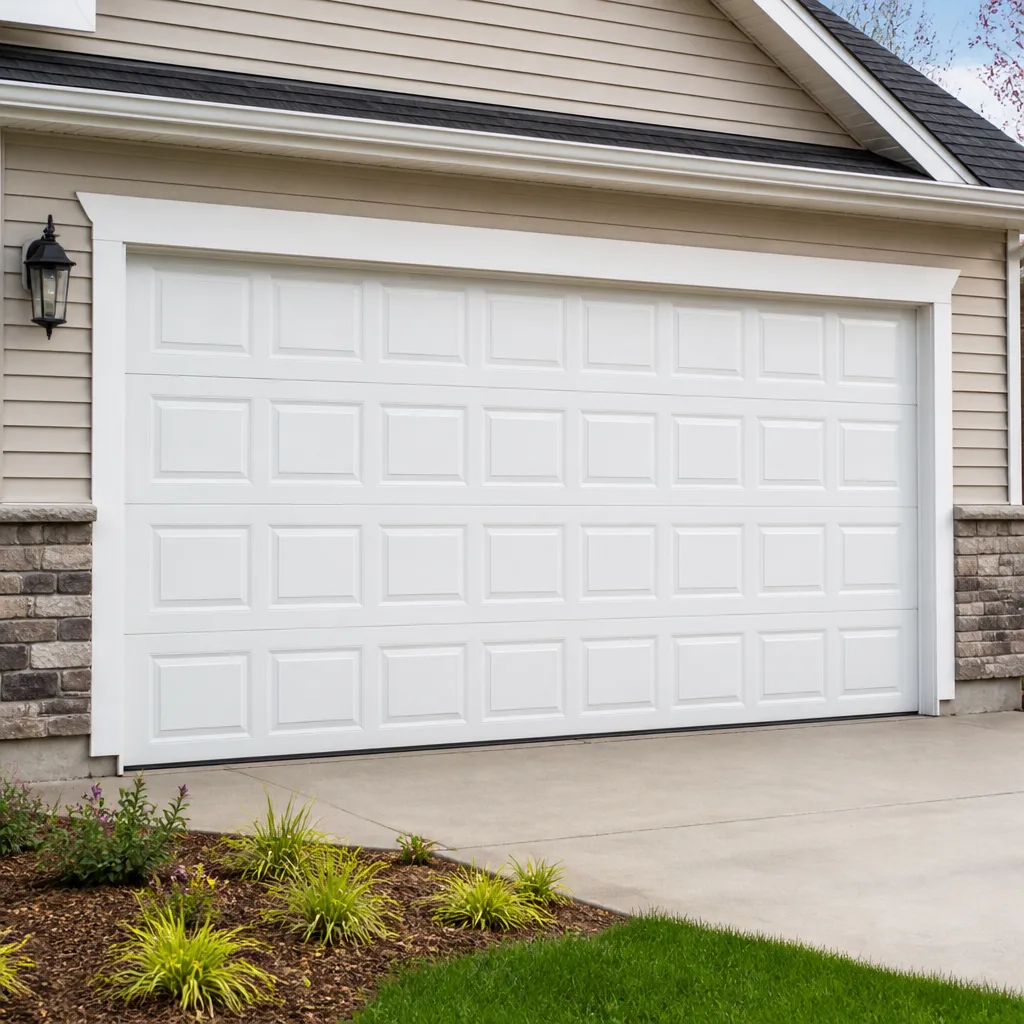 Raised-panel steel
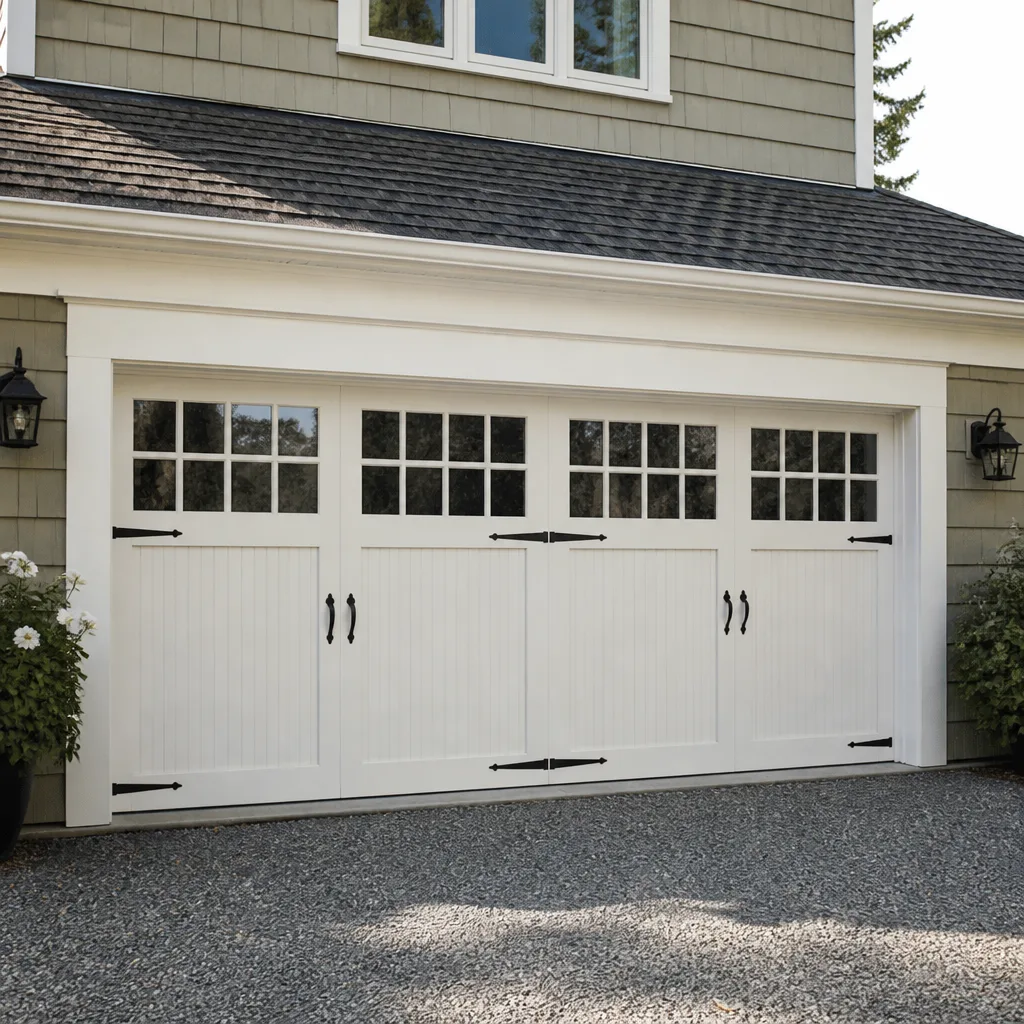 Carriage house
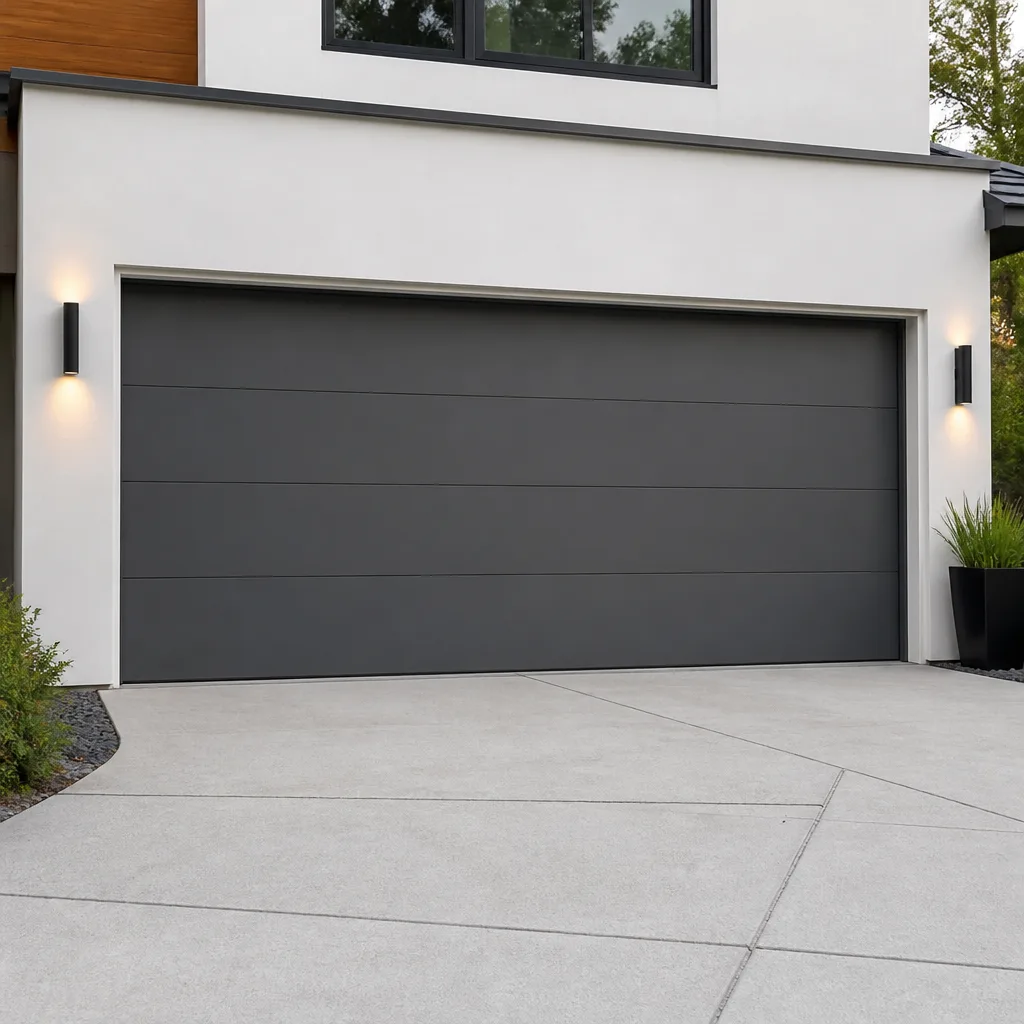 Modern flush
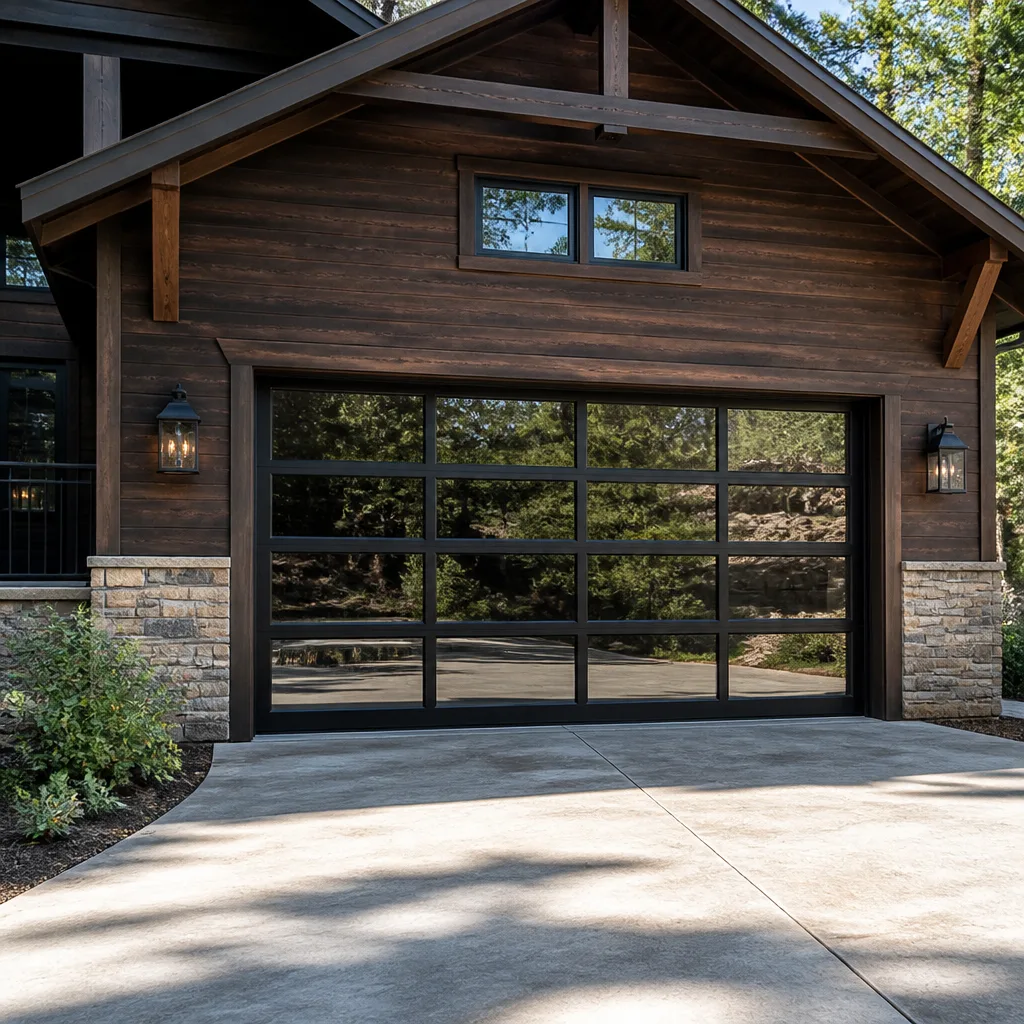 Full-view glass
 LiftMaster openers
 Chamberlain openers
Full 25-point door and opener safety check with every visit - springs, cables, rollers, tracks, and your LiftMaster or Chamberlain opener included
You get a price before we start. It does not change when the truck arrives.
Get your free estimateDIY vs Professional Garage Door: The West Palm Beach Homeowner’s Decision Guide
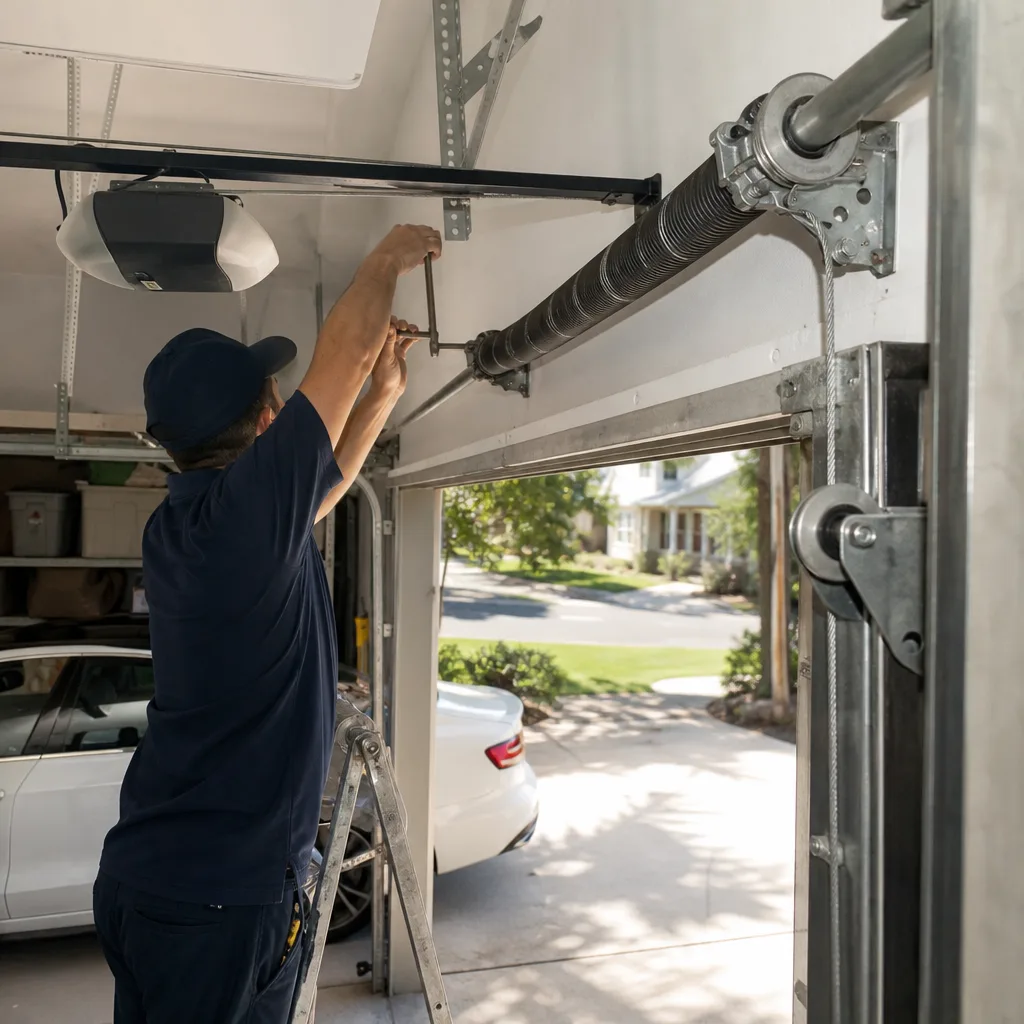
Torsion spring replacement sends more homeowners to Florida emergency rooms than any other garage door repair task. It’s also the job most commonly attempted after watching a single YouTube tutorial, because the video makes it look manageable right up until the spring releases. This guide draws the line between what you can safely handle yourself and what you shouldn’t touch, with West Palm Beach building codes, humidity, and warranty realities factored in, and points you to our Garage Door Emergency Preparedness Guide for West Palm Beach Homes for storm-season planning.
Quick Answer
DIY garage door work is genuinely safe for about 15 percent of common maintenance tasks: lubrication, bottom seal replacement, remote programming, and weatherstripping. Everything else, especially torsion spring work, cable replacement, and any repair involving Florida permit requirements, carries legal, physical, and financial risk that makes professional service the only rational choice for most West Palm Beach homeowners.
Styles & brands we work with
Table of Contents
- What You Can Actually Do Yourself
- What Florida Requires a Licensed Contractor to Do
- Why Torsion Springs Are Not a Judgment Call
- The Warranty Problem Nobody Tells You About
- The Real Cost Comparison: DIY vs Professional
- What West Palm Beach Conditions Do to Garage Doors
- Step-by-Step: The DIY Tasks You Can Do
- When to Call a Professional
What You Can Actually Do Yourself
Let’s start with the honest list. In our experience working on garage doors across West Palm Beach, these are the tasks a homeowner with basic tools can handle without risking injury or voiding a warranty:
- Lubricating rollers, hinges, and tracks with a silicone-based spray designed for garage doors. Skip the WD-40. South Florida humidity demands a dry silicone formula that won’t attract sand and salt.
- Replacing the bottom seal when you see daylight or water pooling under the door during summer storms. This is a straightforward slide-out, slide-in job on most doors.
- Programming remotes and keypads for LiftMaster, Chamberlain, and Genie openers. The button sequence is printed on the motor unit or available in the manual.
- Replacing weatherstripping on the side jambs. The adhesive-backed vinyl strips at any hardware store work fine, though we recommend the wider profiles for West Palm Beach’s wind-driven rain.
- Tightening loose hinge bolts with a socket wrench. Do this every six months and you’ll prevent most door noise issues.
None of these tasks require touching anything under tension. None of them require a permit. None of them void a manufacturer warranty. That’s the test, and it’s a good one: if the task requires a tool you don’t already own, or involves anything with a warning label on it, stop and reconsider.
The Lubrication Schedule That Prevents Most Repairs
Salt air and humidity in West Palm Beach accelerate metal wear. A simple maintenance routine costs under $20 a year and prevents roughly 40 percent of the repair calls we see:
- Every three months, spray the rollers (wheels only, not the bearings), hinges, and springs with silicone lubricant.
- Every six months, check that hinge bolts and track brackets are snug. Loose hardware is the leading cause of noisy doors.
- Every year, inspect the bottom seal and side weatherstripping for brittleness. Florida UV light breaks down rubber compounds faster than you’d think.
- After any major wind event, run the door through a full open-close cycle and listen for grinding or hesitation.
This is the level of attention that keeps a garage door running for 15 to 20 years in coastal Florida conditions. It’s also the level most homeowners skip, which is why the repair industry stays busy.
What Florida Requires a Licensed Contractor to Do
Florida law draws a firm line, and it’s not about skill. Under Florida Statute Chapter 489, garage door installation and structural repair work that requires a permit must be performed by a licensed contractor. See Garage Door Permits, Codes & Inspections in FL: What You Need to Know for the full requirements. Here’s what that means in practice for a West Palm Beach homeowner:
- Full door replacement typically requires a permit through the City of West Palm Beach Building Department. The permit application must list a licensed contractor. Homeowners can sometimes pull owner-builder permits, but the liability for improper wind-load certification transfers entirely to you.
- Any work that alters the door’s wind-load rating, including replacing panels with non-identical materials, technically requires an engineer’s sign-off in a High Velocity Hurricane Zone. Most of Palm Beach County falls under HVHZ requirements.
- Opener replacement that involves new wiring may require a permit depending on how your municipal inspector interprets the electrical scope. A battery of Florida electrical code provisions applies to hardwired openers.
The takeaway: if the job involves removing something permanently attached to the structure, there’s probably a permit involved. And permits mean licensed contractors. It’s not gatekeeping. It’s wind-load engineering, and in hurricane country, that’s not a bureaucratic formality.
Why Torsion Springs Are Not a Judgment Call
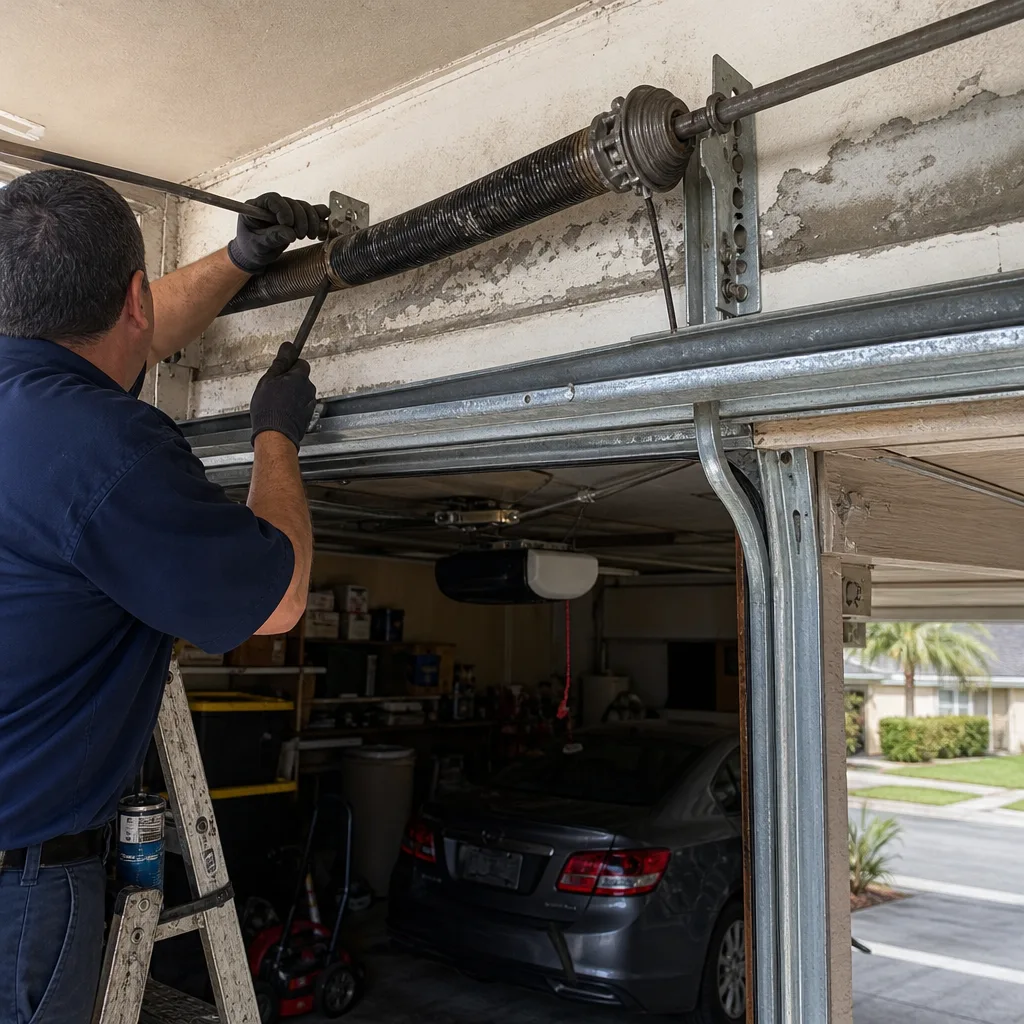
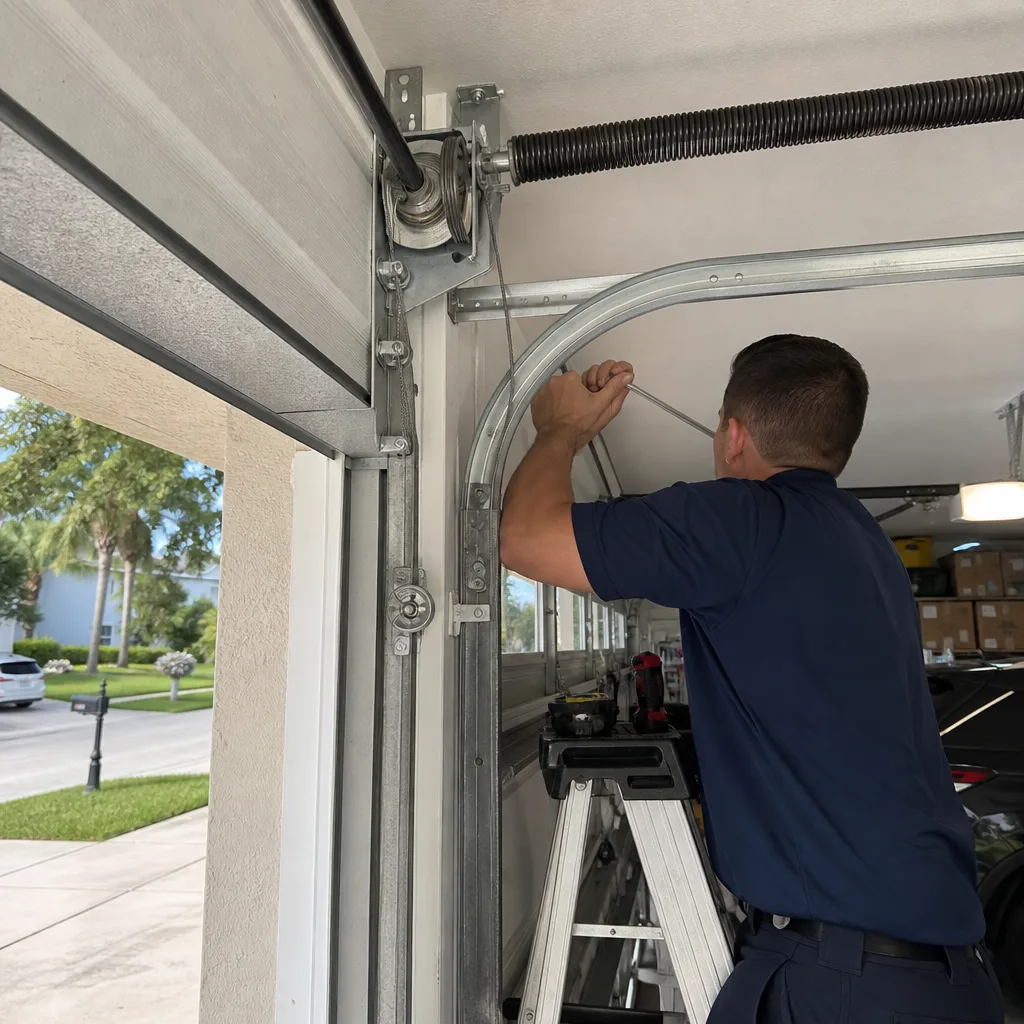
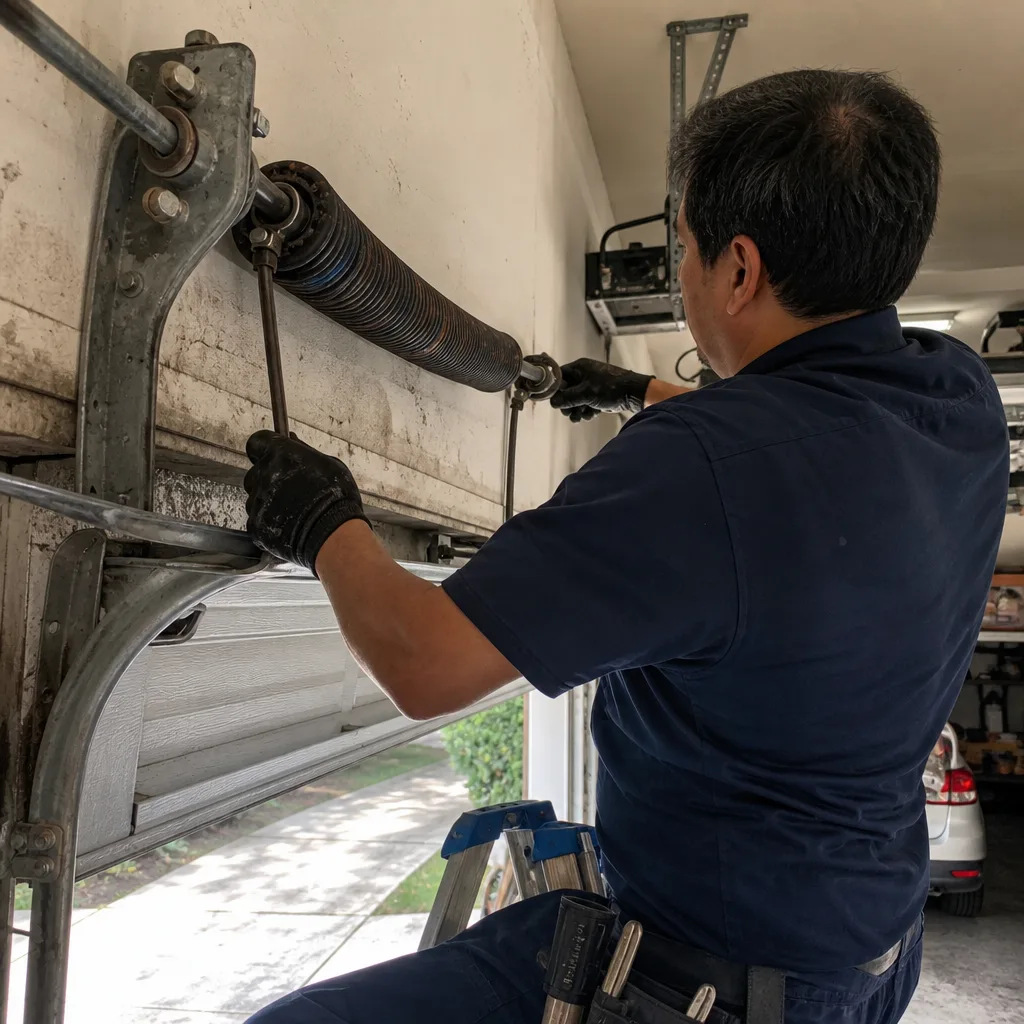
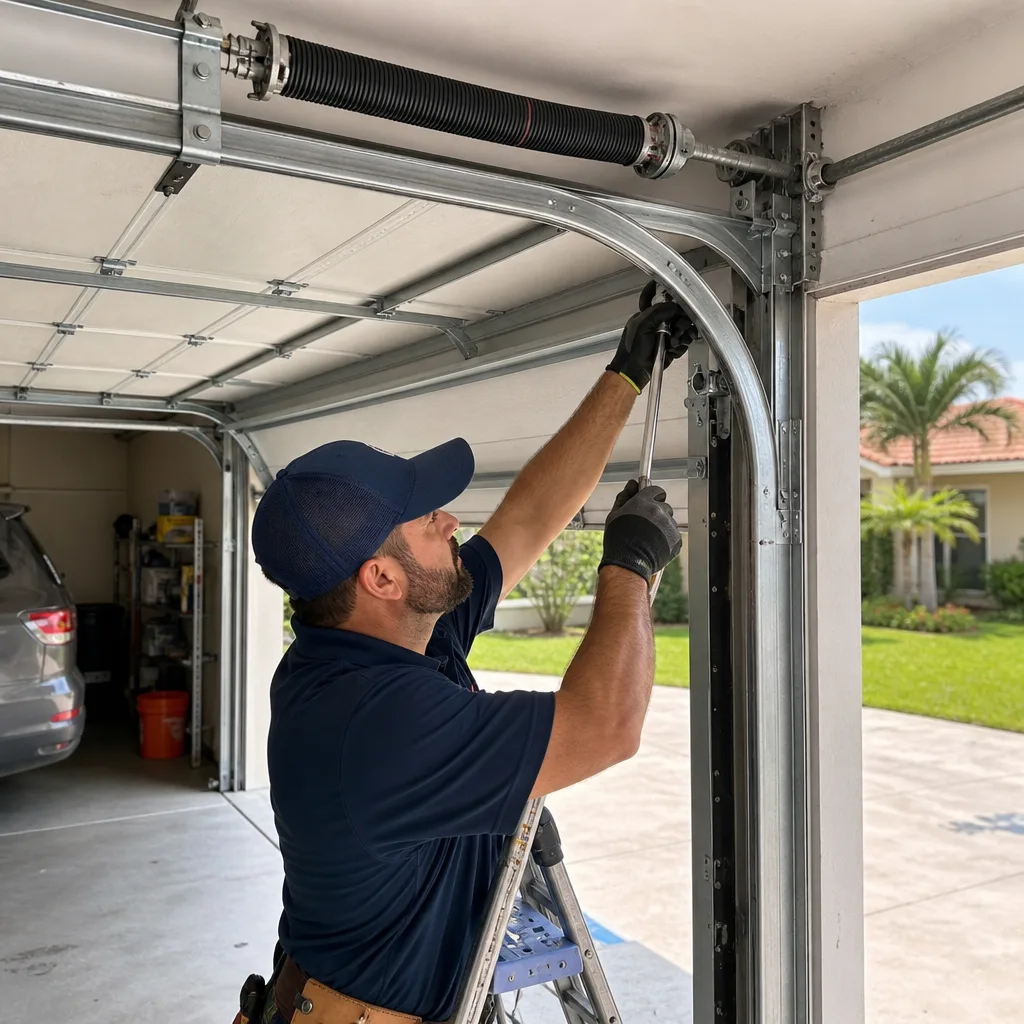
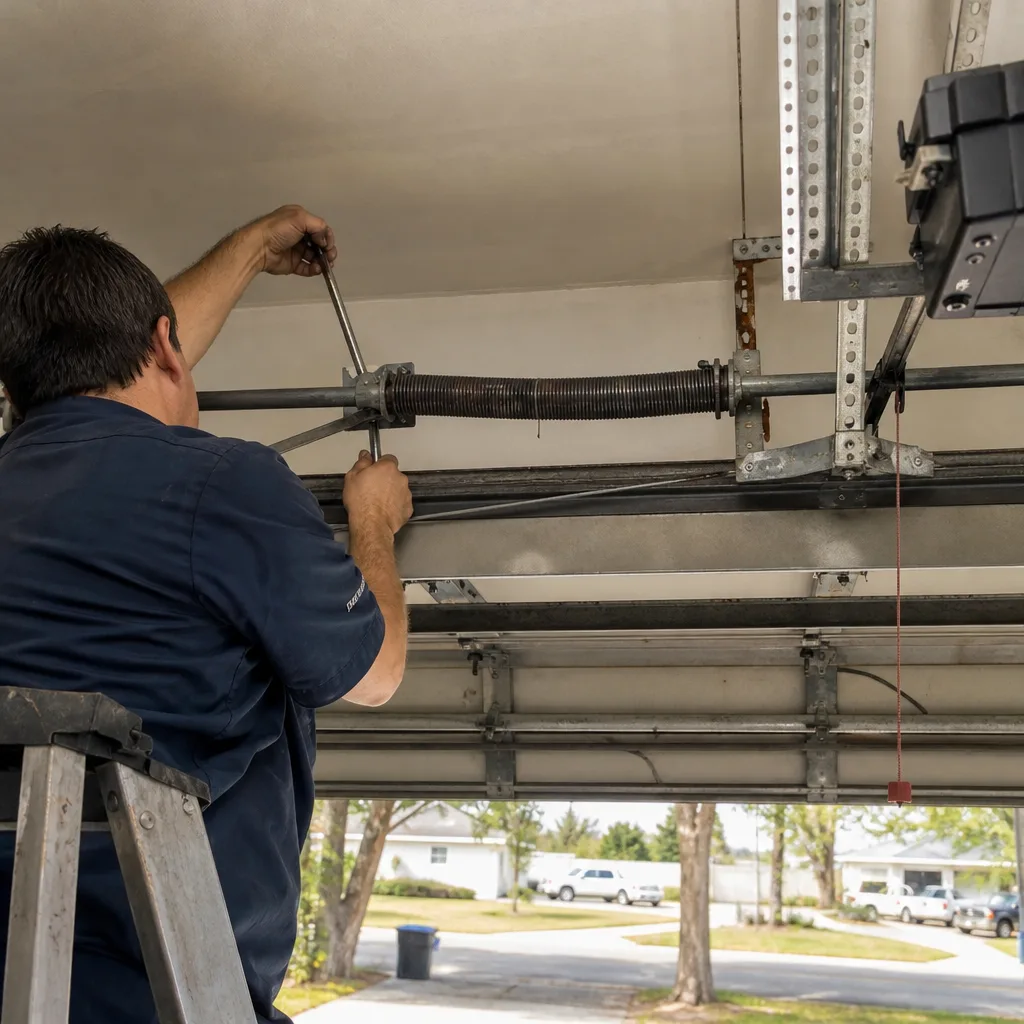
A standard residential torsion spring on a double garage door holds between 100 and 250 pounds of torque, depending on the door’s weight. That energy is released in a fraction of a second when the spring fails or when a winding bar slips. The spring’s cone fitting travels at roughly 200 miles per hour at the moment of release. Human reaction time is about 250 milliseconds. That means by the time you register that something went wrong, the spring has already gone through whatever was in its path.
This isn’t theoretical. Torsion spring injuries show up in the National Electronic Injury Surveillance System data every year, and a significant percentage involve forearm fractures, facial lacerations, and finger amputations. The common thread in most of those incidents: the homeowner used improvised tools instead of proper winding bars, or loosened the set screws without understanding that the spring was still loaded.
We are not telling you this to scare you. We’re telling you because every year we get calls from West Palm Beach homeowners who watched a tutorial, bought a spring from a discount site, and ended up with a garage door that fell off its tracks or a spring that failed a month later because it was sized by guesswork. The physics doesn’t care about confidence. The winding bar doesn’t care about experience. It’s a mechanical system, and it will do what physics says it will do.
The Warranty Problem Nobody Tells You About
Clopay and Amarr both state in their written warranty documents that installation must be performed by a qualified professional for coverage to remain valid. Chamberlain states in its opener manual that failure to follow installation instructions, including torque settings on the opener’s force adjustment, voids the warranty. Genie has similar language. Here’s what that means in plain terms: if you install a door or opener yourself and the product fails six months later, the manufacturer will ask for proof of professional installation. When you can’t provide it, the warranty claim is denied.
What does a voided warranty actually cost? Here’s a representative table for a typical West Palm Beach double garage:
| Component | Typical Warranty Coverage | Replacement Cost Without Warranty |
|---|---|---|
| Door panels (Amarr, Clopay) | 10 years to lifetime, prorated | $400 – $1,200 per panel |
| Chamberlain opener motor | Lifetime on motor, 1 – 2 years on parts | $300 – $700 installed |
| Torsion springs | Varies by installer; typically 1 – 2 years | $180 – $340 parts and labor |
| Track and hardware | Often bundled with door warranty | $150 – $400 |
When you buy a door from a big-box store and install it yourself, you effectively trade a 10-year warranty for a one-time labor saving of roughly $400 to $800. That math rarely works in the homeowner’s favor.
We service all of these brands, including Chamberlain, Genie, Clopay, and Amarr, and we’ve assisted homeowners whose self-installed doors failed under warranty claims. It’s never pleasant to explain that the coverage evaporated at the moment of installation.
The Real Cost Comparison: DIY vs Professional
Let’s talk actual numbers for the West Palm Beach market. For a detailed breakdown, see our Garage Door Cost Breakdown: The West Palm Beach Homeowner’s Reference for 2026. A homeowner watching a tutorial sees the spring for sale online at $60 and assumes that’s the cost. Here’s the full picture:
DIY torsion spring replacement:
- Spring pair: $60 – $120 (online, unverified sizing)
- Winding bars: $30 – $50 (or improvised, which is worse)
- Time: 3 – 6 hours if nothing goes wrong
- Risk: severe injury, door damage, incorrect spring sizing
- Warranty: none on labor, none on future failure
- Permit: none, but a failed install can trigger a code complaint from an HOA
- True cost range: $90 – $170 plus risk
Professional torsion spring replacement:
- Springs and labor: $180 – $340 typical in West Palm Beach
- Time: 60 – 90 minutes
- Risk: insured, bonded professional assumes it
- Warranty: typically 1 – 2 years on springs, covered by the service provider
- Permit: handled if required
- True cost range: $180 – $340, all in
The gap between $150 and $300 is the cost of safety, proper spring sizing, and a warranty. When you factor in the cost of an urgent care visit for a hand injury, the DIY route loses every time.
For opener replacement, the comparison tilts even further toward professional service. A Chamberlain or Genie opener costs $180 – $300 at retail. Professional installation adds $150 – $250. The professional route includes the opener, the install, programming, safety sensor alignment, and haul-away of the old unit. The DIY route includes a trip to the store, four hours of ceiling work, and the very real possibility of a garage door that opens but won’t close because the force settings are off. We get that callback every month. We charge more to fix a botched install than to do it right the first time.
What West Palm Beach Conditions Do to Garage Doors
West Palm Beach is a distinct environment for garage doors, and the differences show up in repair patterns. Salt air from the Atlantic, combined with summer humidity that rarely drops below 70 percent, accelerates corrosion on hinges, brackets, and springs. Spring failure in coastal neighborhoods like El Cid, Flamingo Park, and Southland Park happens on average 2 to 3 years earlier than in inland communities like Royal Palm Beach or Wellington.
Wind-load requirements under the High Velocity Hurricane Zone code add another layer. Every garage door in Palm Beach County is rated for specific wind pressures. That rating depends on the panel thickness, the strut configuration, and the track gauge. When a homeowner replaces a panel or tries to reinforce a door without understanding the wind-load math, the result can be a door that fails inspection or, worse, fails during a hurricane.
We also see a pattern specific to older West Palm Beach homes. Many houses built between 1950 and 1980 have garage openings that are not square. The concrete drifted over decades of heat and soil settling, and the track work compensates for it. A new door installed by a novice using standard measurements will bind immediately. The professionals who work in this market know the older neighborhoods and expect the drift.
This is where a dedicated garage door company matters. The West Palm Beach Garage Door Co home team works on doors across the city and understands the condition patterns in the neighborhoods we serve. For homeowners in nearby communities, we also provide Garage Door Repair in Loxahatchee Groves, bringing the same brand-wide expertise to the western communities where rural properties have their own distinct issues with long gravel driveways and detached garages.
Step-by-Step: The DIY Tasks You Can Do
Here are the exact steps for the four genuinely safe DIY tasks. These do not void warranties, do not require permits, and do not put you near anything under tension.
1. Lubricating the Door
- Close the door completely.
- Purchase a silicone-based garage door lubricant. We recommend Blaster or 3-IN-ONE brands.
- Spray the roller bearings (the metal wheel part, not the nylon surface).
- Spray each hinge pivot point.
- Spray the torsion spring lightly along its entire length.
- Run the door through one open-close cycle and wipe any drips.
2. Replacing the Bottom Seal
- Measure the width of the door exactly.
- Order a replacement seal with a T-channel or U-channel profile, depending on your door’s retainer.
- Open the door to waist height and use vice grips to hold the door in place.
- Slide the old seal out of the retainer channel.
- Lubricate the new seal with soapy water and slide it in.
- Trim the ends flush and close the door to check the contact.
3. Programming a Chamberlain or Genie Remote
- Locate the “Learn” button on the motor unit (usually a colored square on the back).
- Press and release the Learn button. The indicator light will glow.
- Within 30 seconds, press the button on the remote you want to program.
- Wait for the opener light to blink, confirming the signal was received.
- Test the remote from inside the car at the usual parking distance.
4. Replacing Side Weatherstripping
- Peel off the old vinyl strip. If the adhesive remains, use mineral spirits to soften it.
- Measure the jamb height and cut new strips to length.
- Peel the backing and press the new strip into the jamb channel or onto the jamb surface.
- Check that the door compresses the seal on both sides when closed.
Again: this list is complete. If the task you’re considering isn’t on it, it’s probably not a DIY job. The line between safe and dangerous in garage door work is sharp, and it’s not worth testing.
When to Call a Professional
Call a licensed garage door specialist when any of these apply: the door won’t open or close and you can’t identify the cause within ten minutes of visual inspection; you hear a loud bang from the spring area (the spring has failed); the door is off its tracks; the door opens unevenly or sags to one side; the opener is running but the door isn’t moving (broken gear or disconnected drive); the door is making grinding or screeching noises that lubrication doesn’t fix; or the door is over 15 years old and you’re considering replacement to meet current wind-load codes.
Any task involving the torsion spring, the lift cables, or the bottom brackets attached to the cables is a professional job. No exceptions. The cables are under exactly as much tension as the springs, and the same injury physics applies.
West Palm Beach Garage Door Co offers free estimates in West Palm Beach. Call (877) 265-9120 and we’ll give you a written quote before any work starts. No obligation, no pressure. We also provide Garage Door Opener Repair in Loxahatchee Groves for homeowners in the western communities who need opener-specific diagnosis, and Garage Door Installation in Loxahatchee Groves for full door replacement with wind-load compliance handled by our team.
See the difference
 Before
 After
 Before
 After
 Before
 After
Common Mistakes to Avoid
- Using WD-40 as a garage door lubricant. WD-40 is a solvent and rust penetrant, not a lubricant. It actually strips away the existing grease and leaves metal parts vulnerable to West Palm Beach humidity. Use silicone spray only.
- Buying “universal” torsion springs online without measuring the existing spring. Spring wire diameter, inside diameter, and length all determine the wound tension. A spring that’s too weak means the opener strains and burns out. One that’s too strong can rip the door off its mounts.
- Ignoring rust on the lift cables. A rusted cable in a coastal environment like West Palm Beach is a failure waiting to happen. Cables should be inspected every year and replaced when any fraying or rust pitting shows.
- Attempting to “adjust” the force setting on the opener to compensate for a binding door. That force setting is a safety feature. Cranking it up to make a struggling door move is how you end up with a door that crushes something in its path or tears itself apart.
- Skipping the permit on a door replacement, or assuming the contractor will “handle it later.” Unpermitted work shows up at resale, and in West Palm Beach’s active real estate market, an unpermitted garage door will complicate a closing. Always confirm that the contractor pulls the permit.
- Assuming a general handyman can handle garage door spring work. Florida does not require a garage door specialty license for simple repairs, but it does require insurance. A handyman’s general liability policy typically excludes garage door work. If something goes wrong, you’re exposed.
Frequently Asked Questions
Torsion spring replacement in West Palm Beach typically costs between $180 and $340 for a standard double door, depending on the spring’s wire size and whether both springs are replaced. The price is quoted and agreed before any work starts. Call (877) 265-9120 for a free estimate on your specific door.
You legally can pull an owner-builder permit and attempt it, but the wind-load certification requirements in Palm Beach County’s High Velocity Hurricane Zone make it a poor idea for most homeowners. A professional installation typically costs $400 to $800 in labor, which includes the permit, wind-load documentation, and warranty coverage. In our experience, DIY installs on older West Palm Beach homes frequently fail because the garage opening itself has drifted out of square over the decades.
We service LiftMaster, Chamberlain, Genie, Clopay, Amarr, Wayne Dalton, Craftsman, and Raynor. Whatever brand is on your garage, we know it. Our technicians work on the opener and the door in the same visit, whether it’s a Chamberlain opener on an Amarr door or a Genie opener on a Clopay door. No proprietary upsell, no “we only service what we sell.”
In most cases, no, as long as the opener is a plug-in unit using the existing electrical outlet. Hardwired openers and openers that require new wiring may require an electrical permit depending on the scope. We advise on this during the estimate process so there are no surprises at inspection. Opener repair specifically is a subspecialty many companies route to the manufacturer; we handle it in-house, including Garage Door Opener Repair in Loxahatchee Groves for homes in the western communities.
No. We quote the repair or installation price after inspecting the door, and that is the price you pay. If we discover additional issues during the repair, we stop and call you with a specific price for the additional work before proceeding. You can read more about our service philosophy on our West Palm Beach Garage Door Co home page.
Same-day service is available in most of West Palm Beach, and we prioritize emergency repairs where a door is stuck in the open position, leaving the home exposed. Call (877) 265-9120 early in the day for the best chance of same-day dispatch. In unincorporated areas and communities like Loxahatchee Groves, dispatch windows depend on the time of day and current call volume.
The Bottom Line
The DIY-versus-professional question for garage doors comes down to this: four tasks are genuinely safe for a homeowner (lubrication, bottom seal, remote programming, weatherstripping), and everything else involves risks that don’t reward the savings. A pro costs $180 to $340 for a spring replacement, $150 to $250 for an opener install, and $400 to $800 for a full door installation. The DIY savings on those same jobs evaporate the moment you account for tool purchase, warranty loss, and the cost of a failed attempt. In West Palm Beach, where hurricane wind-load codes and salt air acceleration add layers of complexity, the calculation tilts further toward professional service every time. Garage doors are all we do. If you’re not sure which side of the line your task falls on, call us at (877) 265-9120. We’ll tell you straight, and the estimate is free.
Written by the team at West Palm Beach Garage Door Co, serving West Palm Beach since 2013. Browse more guides & resources on garage door safety and maintenance.